Home Sweet Home

Sometimes there’s a surprise silver lining, as there was for Michael & me in the midst of needing to leave Ecce Homo and Jerusalem two weeks before originally scheduled. A fellow volunteer, Gylan, a seminarian from Malta, was called back to Malta early. Our flights would be March 17 at similar times. We reserved a 4:30 a.m. taxi to Tel Aviv together, with a very dependable driver named Magid, who was happy for the work, as tourism has come to a standstill.

Mike thought we’d breeze through the Old City, but we were amazed at how many cars and people Magid had to weave through, as Muslim worshipers were up early to pray.

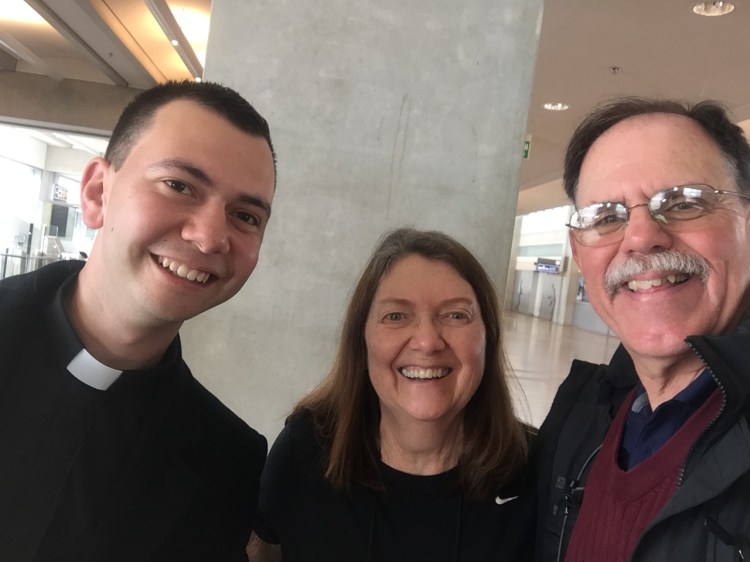
At Ben Gurion Airport, we parted ways with Gylan for different security lines. Walking through the terminal later, we were delighted to see Gylan again, just before he boarded his plane, which had only FOUR passengers. We were glad to be able to say goodbye to Gylan, a fine young man, one more time.IMG_9554

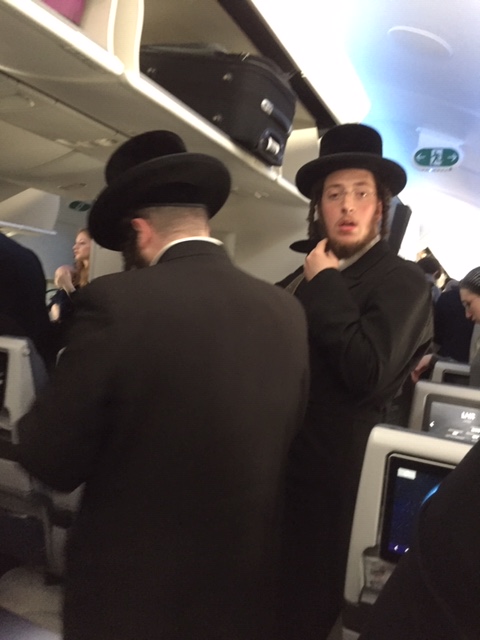
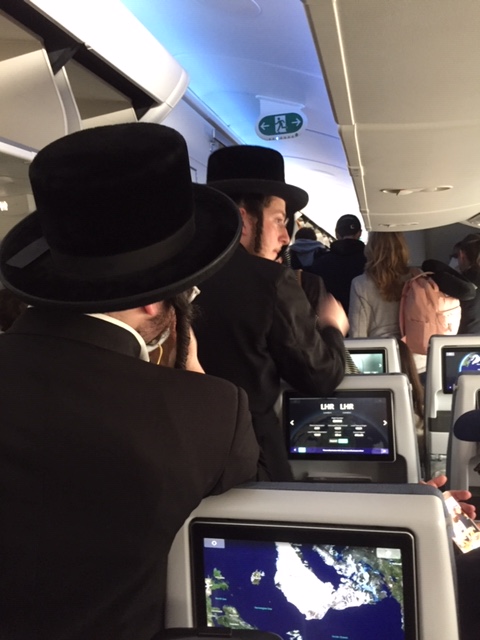
In contrast to Gylan’s sparcely filled plane, our El Al flight to London was packed! We think our Boeing 787 must have had its full capacity of 242 people. LOTS of Hasidic Jews trying to find overhead space for their hats, and LOTS of young families with crying babies. They all seemed to be in the last 1/3 of the plane, where we were. Watching their challenges was more entertaining than the movies offered.

Boarding

IMG_9559IMG_9561

Disembarking

Onward from London’s Heathrow to Chicago, on British Airways.

IMG_9564

Over Canada

At Chicago’s O’Hare, we had a smooth process as workers pointed infrared thermometers at the foreheads of us arriving passengers to test for fever/possible coronavirus. We both passed with flying colors (no pun intended) at 97.7 degrees each. We were given papers from the CDC to record our temps morning and evening for the next 2 weeks.

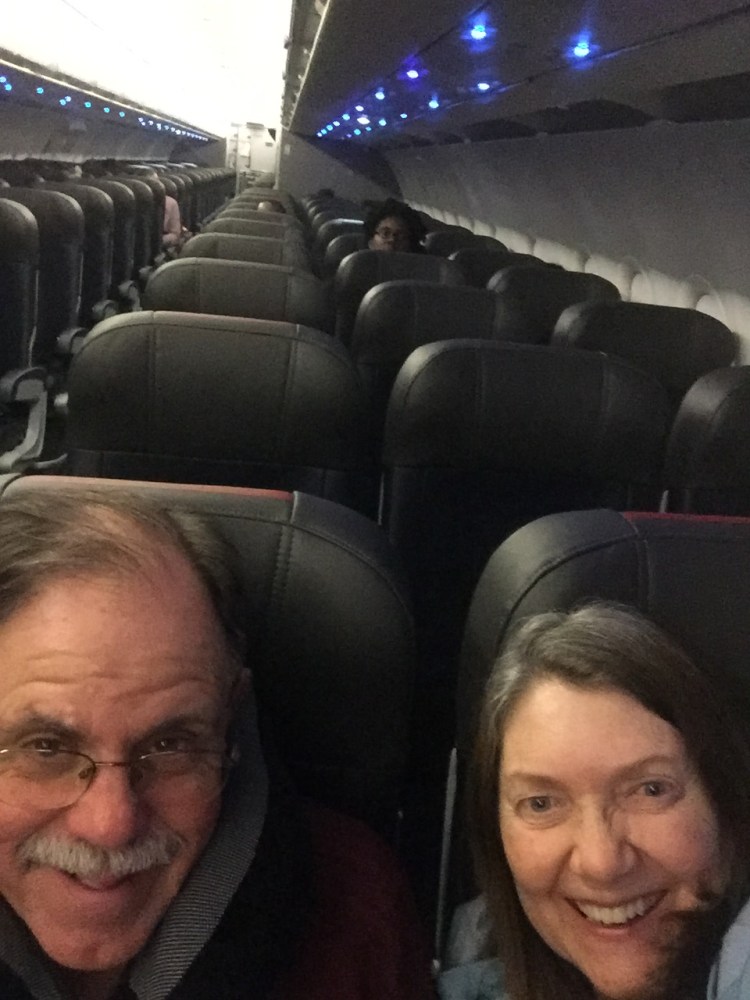
There were only 17 passengers on our American Airlines flight to Charlotte. IMG_9565

Less than two hours later, it was good to see the lights of Charlotte.

IMG_9577

We arrived at Charlotte about 12:30 a.m. and slept in the Quality Inn near the airport, about 27 hours after we got up at 3:30 a.m. in Jerusalem.

Our son-in-law Erron’s parents, Sue & Joe, had been housesitting for us during our 2 and 1/2 months away. They got to enjoy more grandparent time than usual, and a milder winter than their Nebraska’s. They graciously brought us our car. We had a short conversation but  kept our social distance, Mike & I by a second-floor railing, Sue & Joe in the parking lot. Mike & I stocked up on groceries on the way home to our self-imposed quarantine.

Our luggage didn’t arrive with us. My suitcase was found and delivered later, American is still looking for Mike’s.

We’re trying to maintain the Ecce Homo healthy lifestyle, including walking and weeding, and I made lentil soup with lots of veggies.

We plan to continue this blog. We have more photos, short videos, and stories to share.

FYI, if you’d like to listen to calming classical music during this anxious time, you can stream wdav.org out of Davidson, NC, as we did in Jerusalem, and as we listen to at 89.9 FM daily.

Love & prayers,

B.J. & Michael


Early Return

Michael & I are scheduled to fly home in less than 24 hours, on March 17 ☘️, inshallah (God willing), rather than the original departure date of March 31.

Due to coronavirus restrictions into and in Israel, our Ecce Homo Reservations Office has become, as one worker wryly observed, our Cancelations Office. With so many fewer pilgrims to serve, Sister Rita, our director of volunteers, gave Mike & me her blessing to get an earlier flight home. Otherwise, if more flights become canceled, we’d be scrambling to leave before our three-month visa expires April 1.

When we get back to North Carolina, we plan to self-quarantine as much as possible for 2 weeks. We don’t have symptoms, but I’d feel terrible if we unknowingly got the virus & infected anyone. We’re in contact with lots of people here, and we’ll be on flights from Tel Aviv to London to Chicago to Charlotte. So who knows if any passengers might unknowingly be contagious 😷.

Some of you may remember the iconic 1975 Viet Nam photo of frenzied people trying to board one of the last helicopters out of Saigon. Things aren’t THAT panicky here, but there’s a feeling of urgency, and much uncertainty for Ecce Homo staff. But this is a loving, praying community with a strong sense of esprit de corps. It’s a beautiful sunny day, which helps. We invite you to join us in praying for these 50+ people. I hope to share with you more photos of them later. We love them. It’s painful to leave. I showed them our written list of all their names, told them Mike & I prayed for them by name yesterday, will continue to do so.
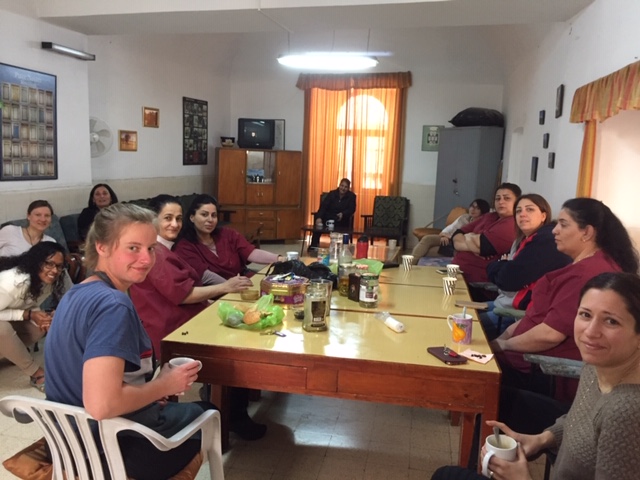
 

IMG_9509

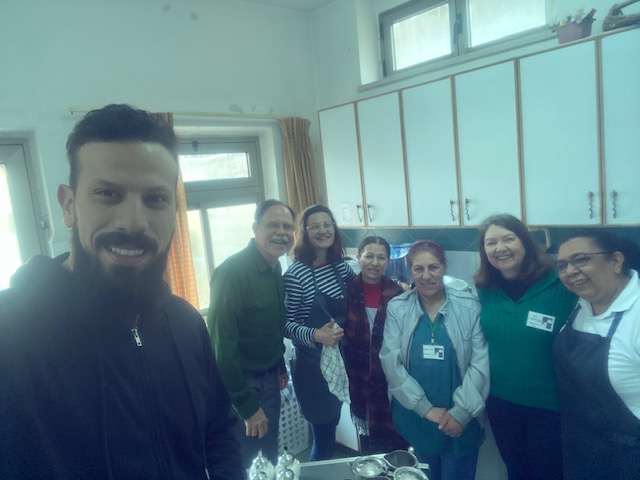
Some of the dear staff, employed or volunteers, on work break this morning

Also, Mike’s mom fell recently, had to have seven stitches in her forehead, was hospitalized to check out her pacemaker, blood pressure, etc. We thank God that she’s doing well and was able to return to her room at a retirement community in Pennsylvania for rehab. We hope to see her when visitors are allowed again.

We were sorry we’d be missing church at St. John’s, but even it’s been canceled for two weeks, so a lot of our fellowship will need to be online or by phone. We were able to worship across the miles yesterday as the pastors and some of the staff led a service, purposely with no one in the pews. IMG_0609
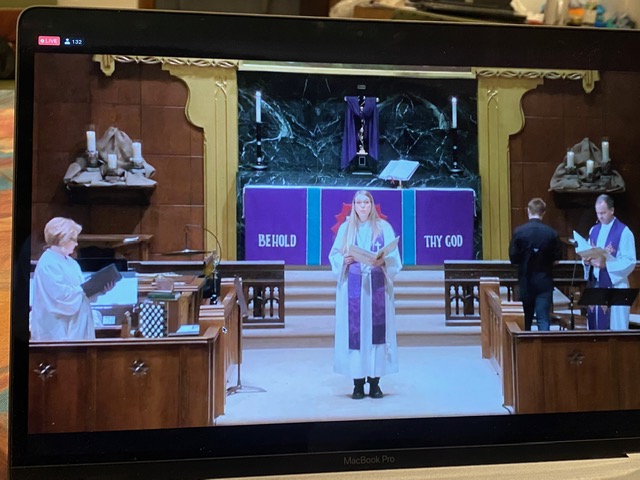
On Mike’s laptop in our room  stjohns-salisbury.org

Life these last few days here haven’t been all gloom & doom, by any means. (“A merry heart does good like a medicine: but a broken spirit dries the bones.” Proverbs 17:22)

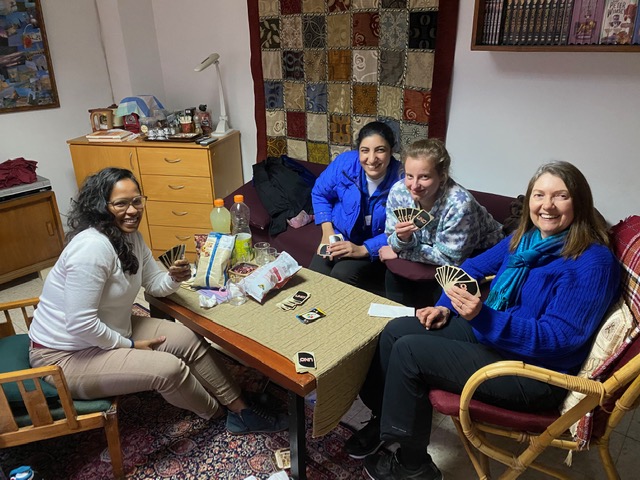
Saturday Mike & I taught friends from Mauritius and France how to play Five Crowns, a card game I learned from a Bible study friend who learned it on a mission trip to Tanzania. So lots of international connections! Then we played Uno.
IMG_0583

Playing Uno in the Volunteers Community Room with, left to right, Sandra from Mauritius (country in East Africa near Madagascar), Sister Wafaa from Egypt, Clarisse from France
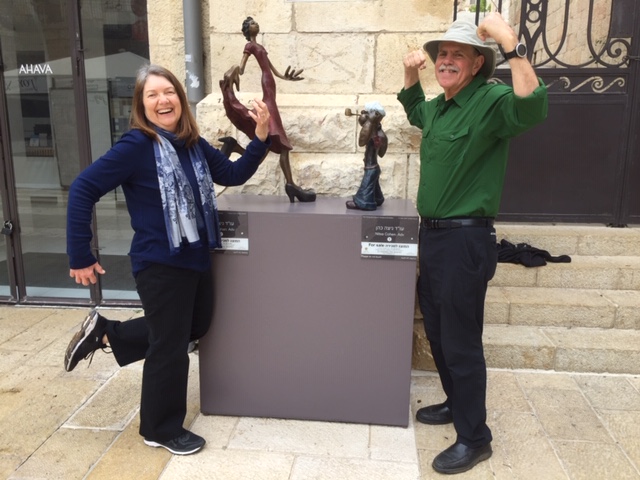
Yesterday morning we walked to Redeemer Lutheran with a friend, Erika, but the two young women at the reception desk said there was no church service. (There aren’t supposed to be gatherings of more than 10 people because of corona concerns.) We walked down a street of upscale stores with outdoor art. Here we’re imitating sculptures of Olive Oyl & Popeye.
IMG_9467

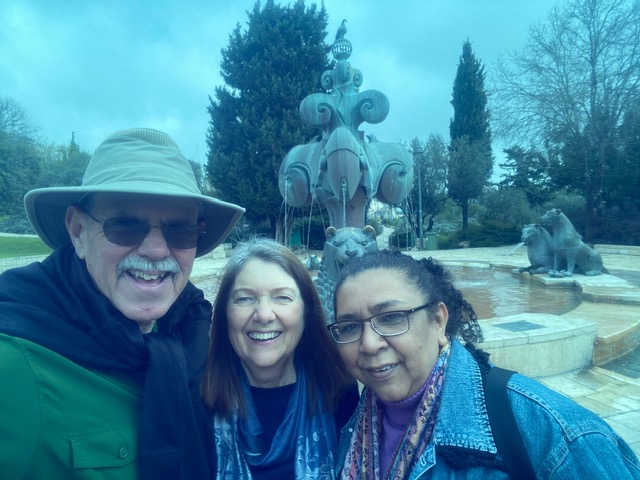
We discovered the Lions Fountain at a Jerusalem park…
IMG_0593

With Sister Erika from Brazil, at Lions FountainIMG_0585
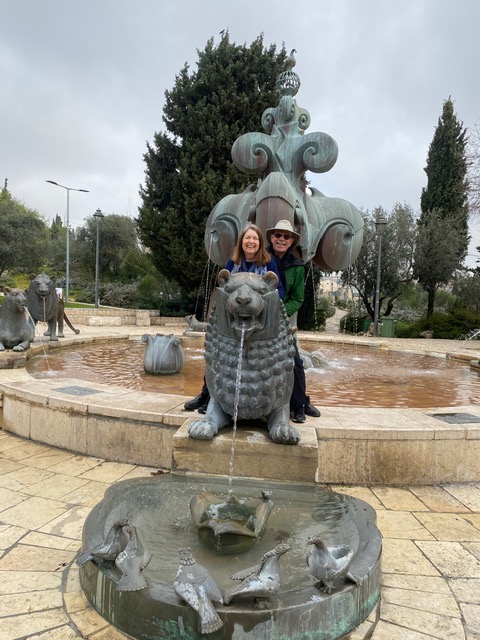
Lions Fountain

… and beautiful tulips near the King David Hotel.
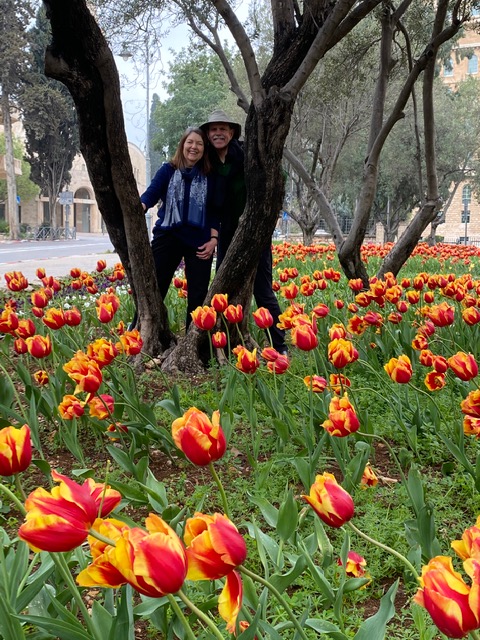
IMG_0597

Four uplifting things to share before finishing packing:

  1. By “Abdu Sharkawy, a doctor and expert at the University of Toronto in Canada”

I’m a doctor and an Infectious Diseases Specialist. I’ve been at this for more than 20 years seeing sick patients on a daily basis. I have worked in inner city hospitals and in the poorest slums of Africa. HIV-AIDS, Hepatitis, TB, SARS, Measles, Shingles, Whooping cough, Diphtheria… there is little I haven’t been exposed to in my profession. And with notable exception of SARS, very little has left me feeling vulnerable, overwhelmed or downright scared.

I am not scared of Covid-19. I am concerned about the implications of a novel infectious agent that has spread the world over and continues to find new footholds in different soil. I am rightly concerned for the welfare of those who are elderly, in frail health or disenfranchised who stand to suffer mostly, and disproportionately, at the hands of this new scourge. But I am not scared of Covid-19.

What I am scared about is the loss of reason and wave of fear that has induced the masses of society into a spellbinding spiral of panic, stockpiling obscene quantities of anything that could fill a bomb shelter adequately in a post-apocalyptic world. I am scared of the N95 masks that are stolen from hospitals and urgent care clinics where they are actually needed for front line healthcare providers and instead are being donned in airports, malls, and coffee lounges, perpetuating even more fear and suspicion of others. I am scared that hospitals will be overwhelmed with anyone who thinks they “probably don’t have it but may as well get checked out no matter what because you just never know…” and those with heart failure, emphysema, pneumonia and strokes will pay the price for overfilled ER waiting rooms with only so many doctors and nurses to assess.

I am scared that travel restrictions will become so far reaching that weddings will be canceled, graduations missed and family reunions will not materialize. And well, even that big party called the Olympic Games… that could be kyboshed too. Can you even imagine?

I’m scared those same epidemic fears will limit trade, harm partnerships in multiple sectors, business and otherwise and ultimately culminate in a global recession. But mostly, I’m scared about what message we are telling our kids when faced with a threat. Instead of reason, rationality, openmindedness and altruism, we are telling them to panic, be fearful, suspicious, reactionary and self-interested.

Covid-19 is nowhere near over. It will be coming to a city, a hospital, a friend, even a family member near you,at some point. Expect it. Stop waiting to be surprised further. The fact is the virus itself will not likely do much harm when it arrives. But our own behaviors and “fight for yourself above all else” attitude could prove disastrous.

I implore you all. Temper fear with reason, panic with patience and uncertainty, with education. We have an opportunity to learn a great deal about health hygiene and limiting the spread of innumerable transmissible diseases in our society.

Let’s meet this challenge together in the best spirit of compassion for others, patience, and above all, an unfailing effort to seek truth, facts and knowledge as opposed to conjecture, speculation and catastrophizing.

Facts not fear. Clean hands. Open hearts. Our children will thank us for it.

2. More calming, perceptive words, this time from C. S. Lewis

C. S. Lewis on the Coronavirus

3. On Sunday, March 1, at Redeemer Lutheran Church in Jerusalem, Pastor Carrie invited congregants to suggest favorite hymns for a short “hymn sing” as people arrived. A woman near the front said, “Have No Fear, Little Flock,” which I appreciated as a brilliant, calming choice for these anxious times.

Have no fear, little flock;
have no fear, little flock,
for the Father has chosen
to give you the kingdom;
have no fear, little flock!

Have good cheer, little flock;
have good cheer, little flock,
for the Father will keep you
in His love forever;
have good cheer, little flock!

Praise the Lord high above;
praise the Lord high above,
for He stoops down to heal you,
uplift and restore you;
praise the Lord high above!

Thankful hearts raise to God;
thankful hearts raise to God,
for He stays close beside you,
in all things works with you;
thankful hearts raise to God!

4. Last but not least, a poem from Sister Rita, from a friend of a friend:

Pandemic
“What if you thought of it
as the Jews consider the Sabbath —
the most sacred of times?
Cease from travel.
Cease from buying and selling.
Give up, just for now,
on trying to make the world
different than it is.
Sing. Pray. Touch only those
to whom you commit your life.
Center down.
And when your body has become still,
reach out with your heart.
Know that we are connected
in ways that are terrifying and beautiful.
(You could hardly deny it now.)
Know that our lives
are in one another’s hands.
(Surely, that has come clear.)
Do not reach out your hands.
Reach out your heart.
Reach out your words.
Reach out all the tendrils
of compassion that move, invisibly,
where we cannot touch.
Promise this world your love–
for better or for worse,
in sickness and in health,
so long as we all shall live.”

Blog readers, thank you for reading. You’ve got your own challenges with closed schools, etc. Feel free to e-mail us prayer requests at mjconnor1982@gmail.com and bjconnor1982@gmail.com.

“The Lord bless you and keep you; the Lord make His face shine on you and be gracious to you; the Lord turn His face toward you and give you peace.”    Numbers 6:24-26

Corona

Let me (B.J.) start by saying that Mike & I are, thankfully, absolutely fine. We’re scheduled to Skype with St. John’s Lutheran in Salisbury, NC, tomorrow, Sunday March 8, early in the 9:27 a.m. service. (Remember to “spring ahead” tonight for Daylight Saving Time.)  🙂

I wanted to post about St. John’s partner church, Christmas Lutheran in Bethlehem, before the Skype visit. But a more pressing matter arose this week: how travel bans, due to fears about coronavirus, are affecting the livelihoods of people we know in Bethlehem and Jerusalem, including the Palestinian workers here at Ecce Homo.

The Church of the Nativity is closed. Bethlehem is on lockdown for a month — people can’t enter or leave. This is stunning news, which will have devastating economic effects. As one article says, this “came as a particular blow to the Biblical town, whose businesses are largely dependent on Christian visitors.”

Those of you who attended the Palestinian lunch at St. John’s in 2014 may remember Joey Canavati, one of the chefs. He’s quoted in the March 5 article below. “‘This affects us dramatically,’ said Joey Canavati, manager of the 58-room Alexander Hotel in Bethlehem. ‘Our workers are essentially laid off… We will be closed down completely.'”

https://www.thestar.com.my/news/world/2020/03/05/palestinian-authority-bars-foreign-tourists-from-west-bank-over-coronavirus

For those of us here at Ecce Homo, there’s a double whammy. Five beloved, valued employees from the nearby Bethlehem area aren’t allowed into Jerusalem — one of our two chefs, a dining room assistant, two housekeepers, and a maintenance man, who count on this paycheck for their families. Also since Thursday, people from France, Spain, Germany, Switzerland, and Austria, can’t enter Israel unless they can prove they have somewhere in Israel to quarantine for two weeks. This is in addition to “foreigners who were in China, Hong Kong, Macau, Thailand, Singapore, South Korea, Japan and Italy in the 14 days prior to arriving.”

As a result, our numbers are way down — many cancellations. There is anxiety among the staff about reduced work hours or even possible layoffs. Your homes and workplaces are probably also abuzz with the topic of coronavirus.

I had trouble sleeping two nights ago, knowing the additional hardship this will cause our affected Palestinian friends, already oppressed, in Bethlehem and here. I tried to focus on “Pray without ceasing” (I Thessalonians 5:17) for them.

Just three days ago, Michael & I took a bus into Bethlehem for a meeting related to a Christmas Lutheran ministry. It was a beautiful sunny day, so I took a photo, with no idea that the Church of the Nativity would be closed two days later.

IMG_9207

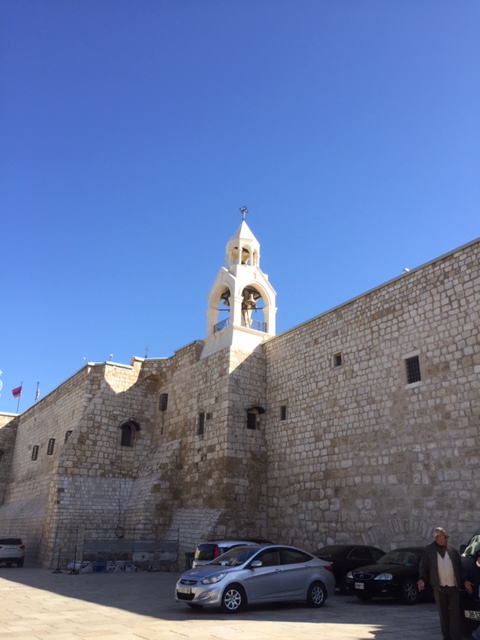
Bell tower of the Armenian monastery by Church of the Nativity

Wikipedia says that the grotto in the church, believed to be Jesus’ birthplace, “is the oldest site continuously used as a place of worship in Christianity, and the basilica is the oldest major church in the Holy Land.”

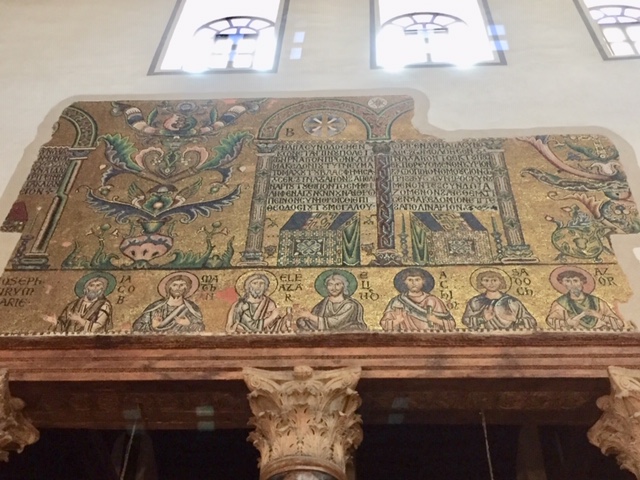
Jerusalem and Bethlehem are only about six miles apart, but travel can take a while because of the checkpoint back. (We have to show our passports to re-enter Israel.) In Mike’s & my jaunts to Bethlehem in the past few weeks, we’ve appreciated being able to pop into the Church of the Nativity to admire its renovated frescos.

IMG_7952

IMG_7953

The entrance is through the “Door of Humility,” about four feet high and two feet wide. One website says it “was created in Ottoman times to prevent carts being driven in by looters, and to force even the most important visitor to dismount from his horse as he entered the holy place.” A University of Notre Dame website says, “The latest resizing was to reduce the opening to prevent a horse from entering. Pilgrims who enter must literally make a profound bow as they pass through. The effect is to experience a birth process of sorts — it reminds us of the humility God took on in joining our humanity.”


Exiting the “Door of Humility”

Our hearts ache for Bethlehem people whose names we know, and for those whose names we don’t, like servers at restaurants where we’ve savored lunches, and taxi drivers who’ve implored us to take their taxi instead of walking, for a few shekels of income.

IMG_9212 Our Tuesday Bethlehem visit ended with a few minutes with Bassem, another of the chefs from the 2014 St. John’s Palestinian lunch. He’s head of the culinary program at Dar al-Kalima University of Arts and Culture, chef at Abu Jubran Guest House, and his family owns a store of olive wood gifts. We’ve had the pleasure of meeting his wife and daughters. We chatted about his parents, and he invited us for a March 15 after-church lunch he would cook for us. Again, little did we know the world would seem to turn upside-down in two days. We won’t get to see Bassem, Pastors Munther Isaac and Mitri Raheb, or anyone else from Bethlehem,  before we fly home March 31, inshallah (God willing).
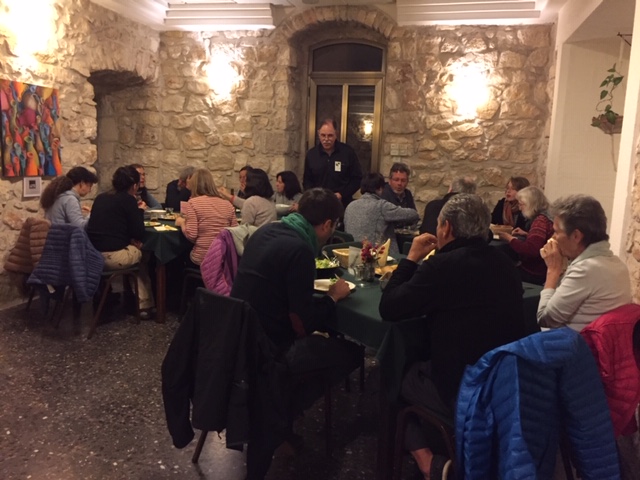
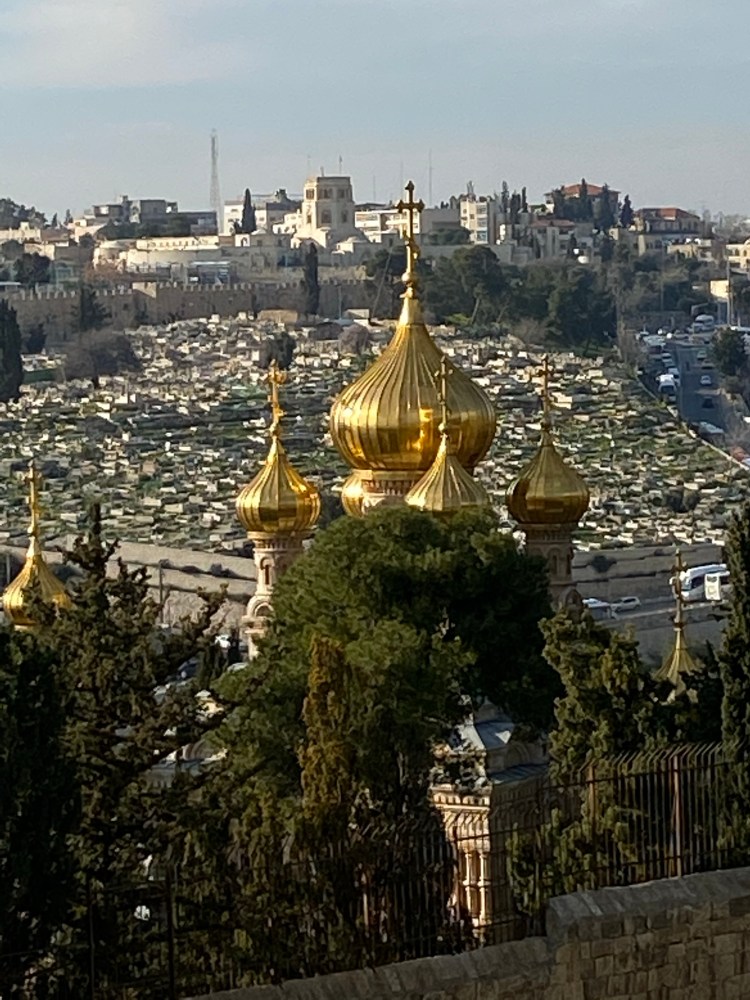
Yesterday was a dreary day of rain and even hail. A departing German Ecce Homo guest made the comment that it seemed like Jerusalem was crying.

Last night we had three tables of dinner guests (total of 16 people). Normally, this close to Holy Week, we would have maybe six times that number — maybe 19 or 20 tables filling all three dining rooms.
IMG_9272

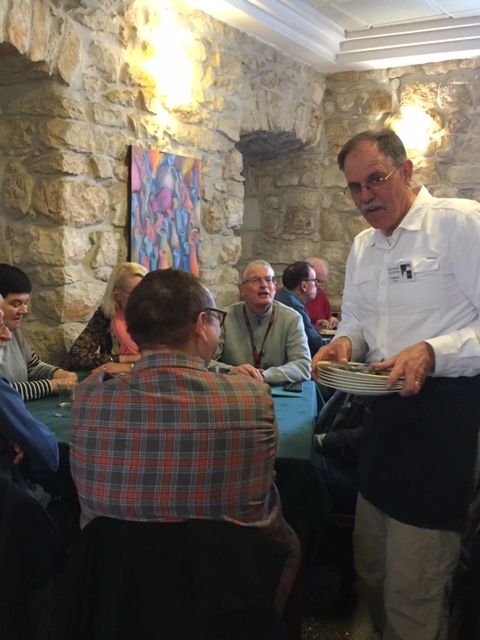
Mike clearing plates at dinner last night

At first the mood was quiet and somber, with a ghost town feel like after 9/11. But as our guests consumed the delicious soup, salad, fish, and potatoes prepared by our remaining chef, the room came alive with laughter and conversations in Spanish, French, and German.

I quoted I Thessalonians 5:17 earlier in this post. Here it is bookended with verses 16 and 18:

Rejoice always, pray without ceasing, give thanks in all circumstances; for this is the will of God in Christ Jesus for you.


Spring Time Pictorial

The following video and pictures give a much better idea of springtime in the  Holy Land than any description by us…

Wildflowers along hiking paths in Ein Kerem (part of Jerusalem commemorating John the Baptist birthplace and Mary and Elizabeth visitation)

This slideshow requires JavaScript.

Hotel California performed by Hasidic Jewish street musician at Mammilla Mall near Jaffa Gate, Old City


Church of Mary Magdalene on Mount of Olives overlooking Arabic cemetery and Old City

img_0428

Pater Noster (Our Father) Garden on Mount of Olives

This slideshow requires JavaScript.


Concluding with the Redeemer Lutheran Church Steeple (Old City) in the morning and early evening


How We Earn Our Bread & Butter (Or Pita & Hummus, As The Case May Be)

Ecce Homo volunteers work 30 hours a week, averaging 5 hours a day for 6 days, with Sundays off. On Saturday nights, Sister Rita, our director, gives us our schedules, which vary from week to week. A large portion of the schedule revolves around meals.

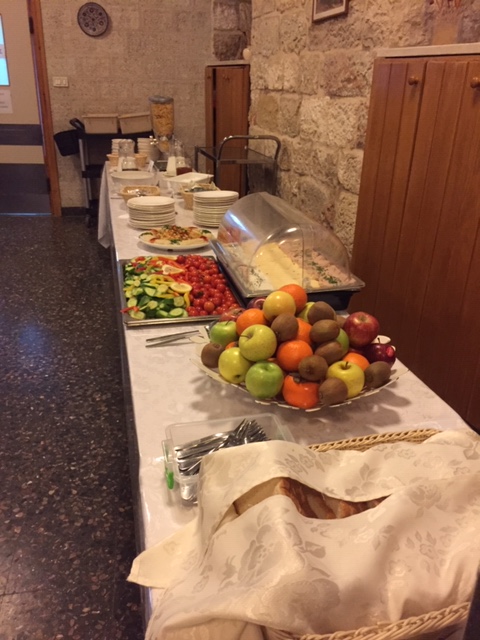
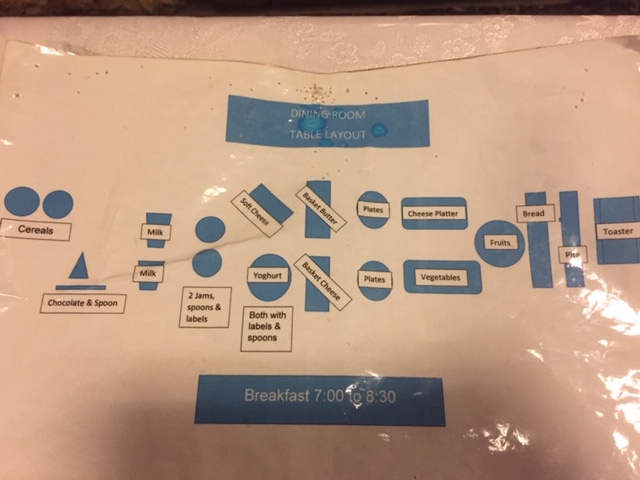
The earliest possible assignment is for 6 a.m. — breakfast prep. The continental breakfast is the same every day, with the Sunday addition of roasted eggs. (I [B.J.] thought they were boiled, but they’re cooked in the oven). It’s a beautiful buffet. A chart helps us remember what goes where until we get the hang of it. If we have a lot of guests (as we do now), two people are assigned to set up buffets in two dining rooms, greet people, and refill items like yogurt as needed.

.IMG_8115

IMG_8533 (1)

To save time in the morning, we can rinse fruit and do other odds and ends the night before.

IMG_8532

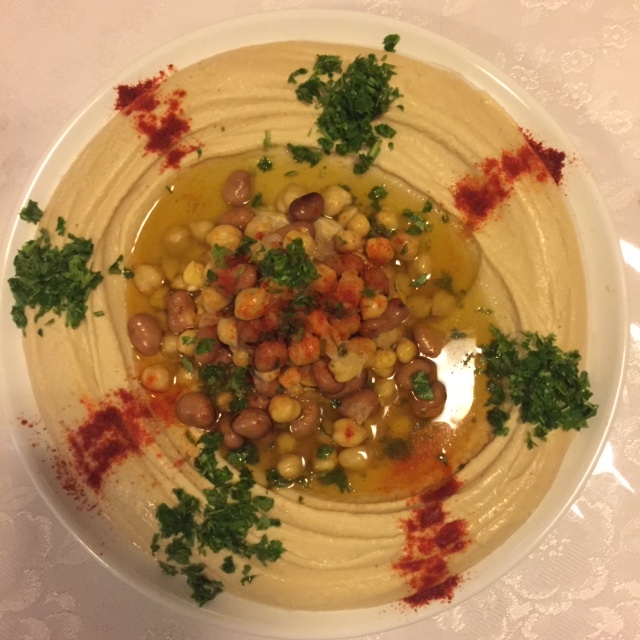
Ecce Homo has two chefs, whose delicious, artistic creations include this hummus. Depending on the nationalities of our guests, some may hardly touch it, some may scrape the plate clean.

IMG_7812

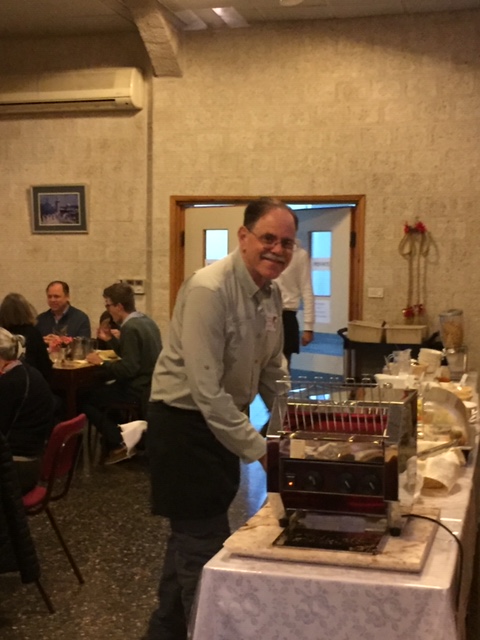
Michael bringing in a bread refill for a group of French breakfast guestsIMG_7813

Refilling bread by the commercial toaster

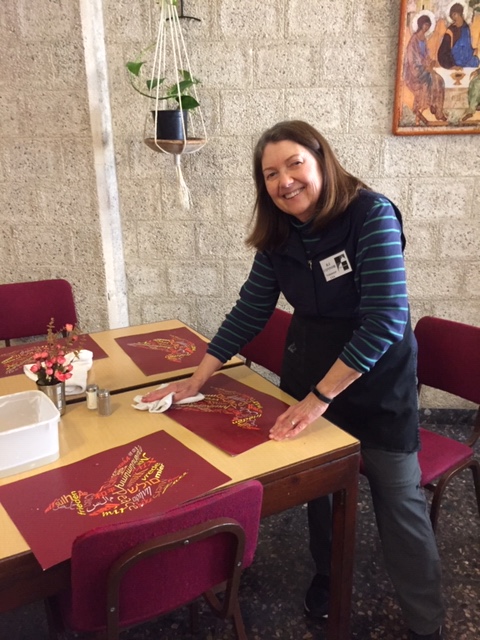
After-breakfast jobs include servers cleaning the tables and setting up for lunch and/or dinner…

IMG_8540

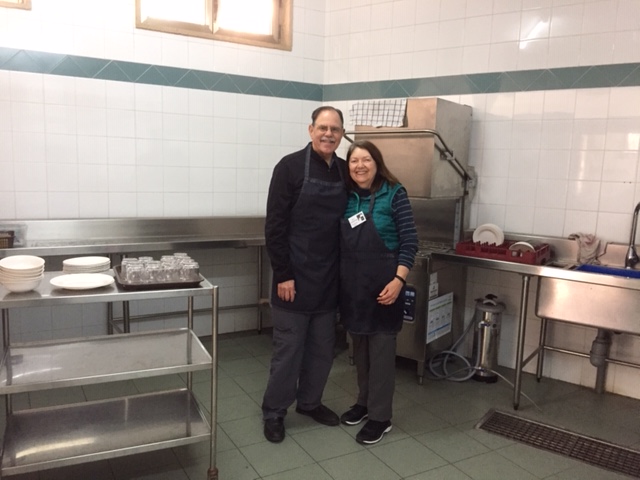
… washing or drying dishes, bowls, cups, silverware, etc., in the “wash-up room”…

IMG_8594

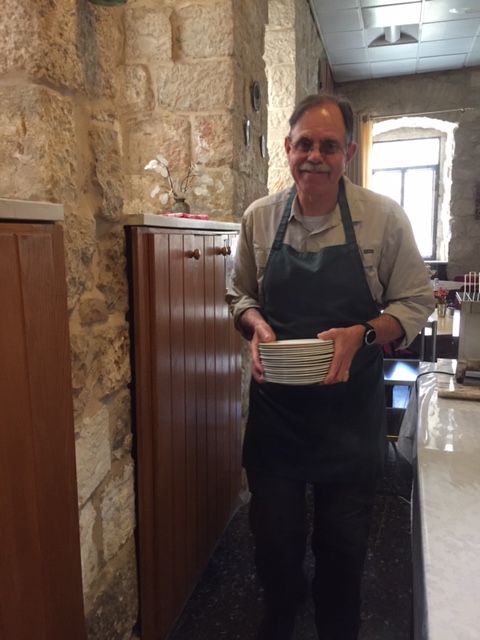
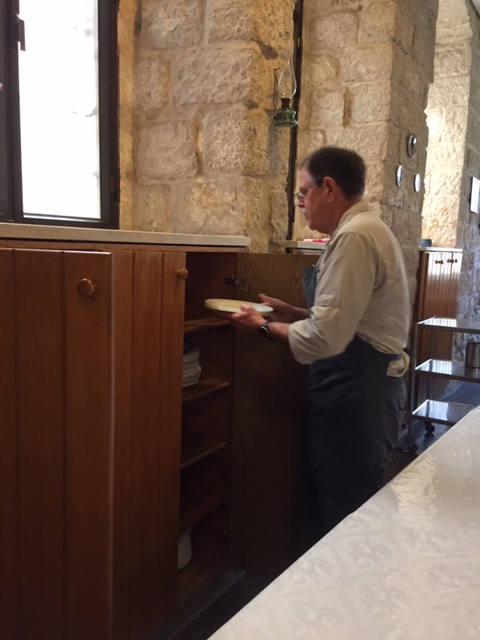
… putting washed, dried dishes into cupboards…

IMG_8538

IMG_8539

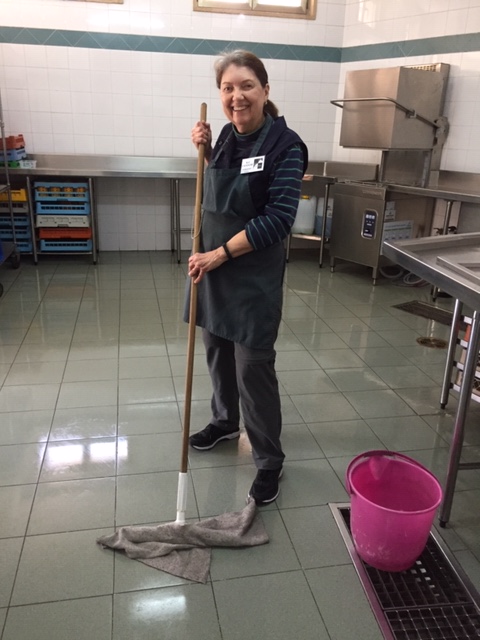
… and, finally, mopping.

IMG_8768 (1)

Mike & I are usually teamed up with other volunteers, sisters (nuns), or paid part-timers, but once in a blue moon, we’re assigned together.

IMG_8014

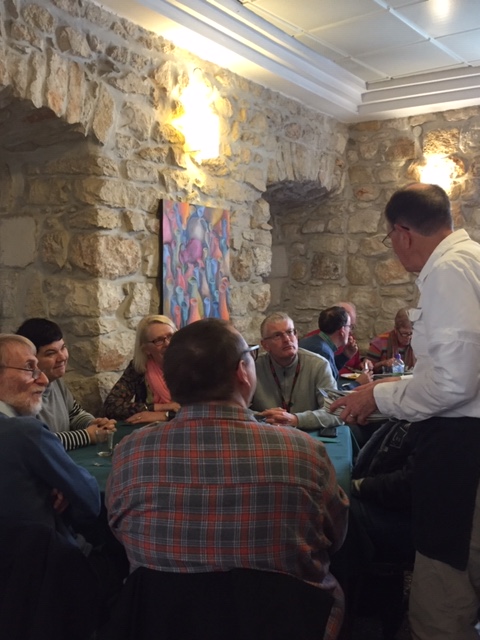
When we’re servers, we like it when there’s dialog with guests. Buoyed by a delicious lunch, these British guests wanted to know where we’re from, what other tasks we do here, etc. One of the men mentioned traveling to Charlotte sometimes for business. We’re not just workers — we try to be ambassadors of goodwill, representing Ecce Homo, the U.S., and, most importantly, Christ.

IMG_8803

IMG_8804

Michael clearing lunch plates before a dessert of carrot cake

RECEPTION:

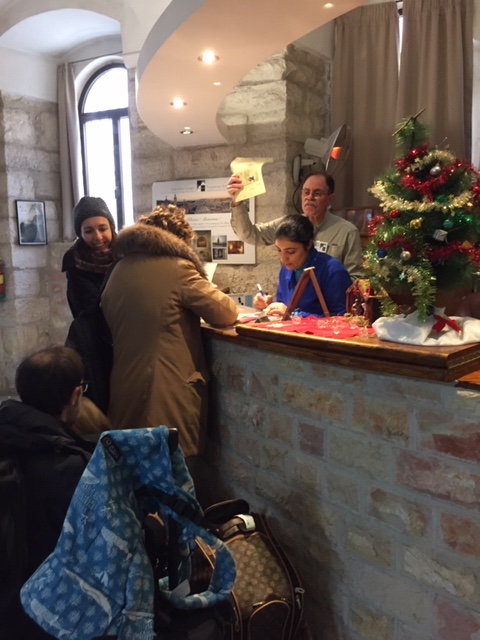
The front desk is called reception. When guests arrive, the workers on reception photocopy their passports. In this picture, Sister Wafaa (from Egypt) and Michael are checking in an Italian family. Mike is about to hand the photocopy for the couple to fill out information.

IMG_7817

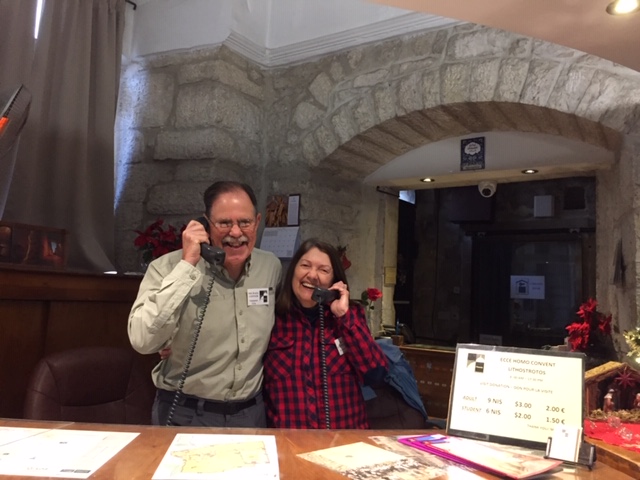
Wafaa thought it would be funny to have us pose as answering both phones at the same time.

IMG_7815

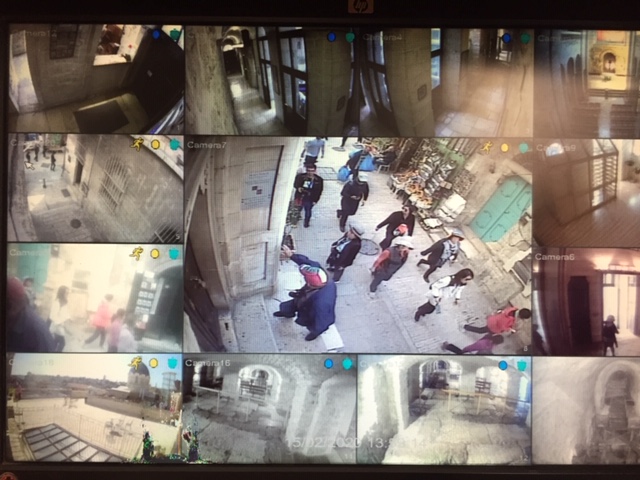
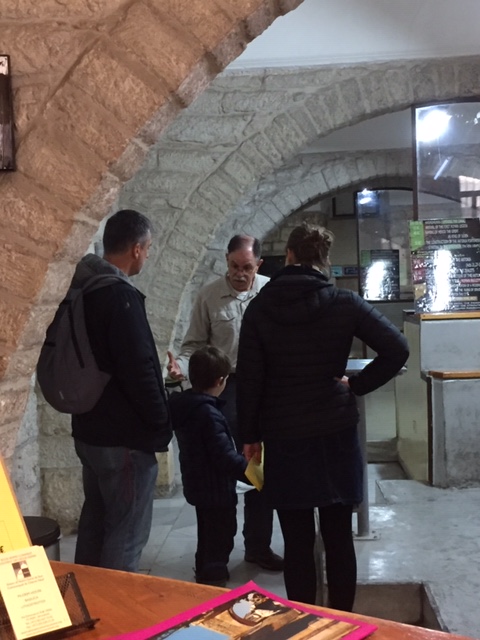
Pilgrim groups come in at street level to see the Lithostrotus in the basement. http://www.eccehomopilgrimhouse.com/litho We handle the paperwork and money from guides and individuals, hand out brochures in the appropriate language, hang up guests’ keys when they go out, etc. With this screen from security cameras, we can monitor above, below, and street views.

IMG_8737

IMG_8819

One day when Mike & I were working reception together, we weren’t busy when this British family came in to see the Litho. Since the six-year-old son, Jasper, is about the age of our grandson Theo, Mike gave Jasper a personal explanation of what in the basement might be of special interest to a boy that age.

OUTDOORS:

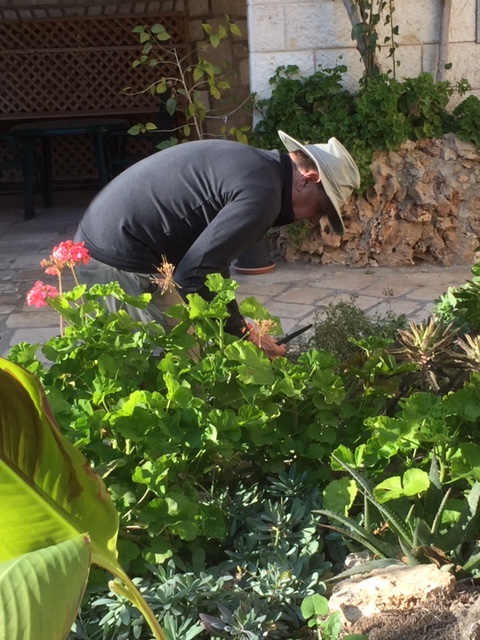
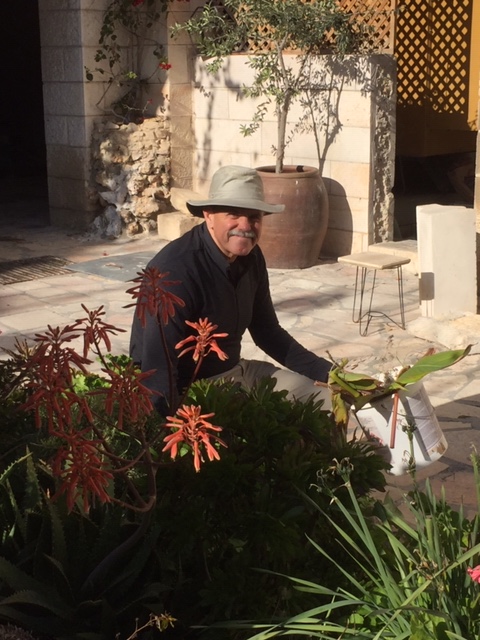
Sister Rita loves to garden, and sometimes schedules us volunteers to help her. Since Michael does the yardwork at our house, he’s very good at this.

IMG_7989

IMG_7993

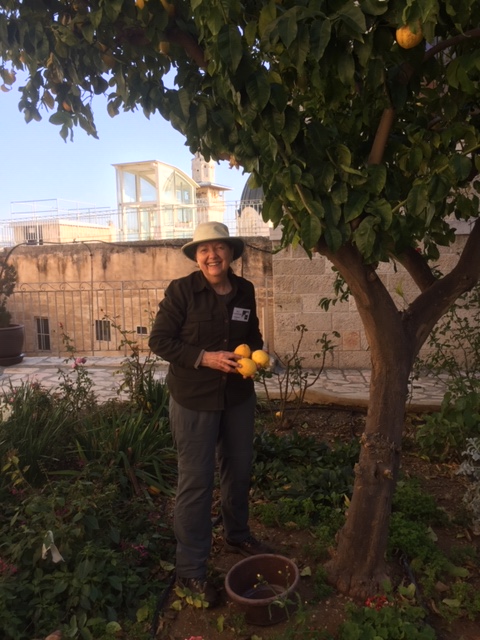
I don’t enjoy weeding, but I did enjoy gathering lemons which had fallen from the garden’s lemon tree. It was like hunting for Easter eggs!

IMG_8003

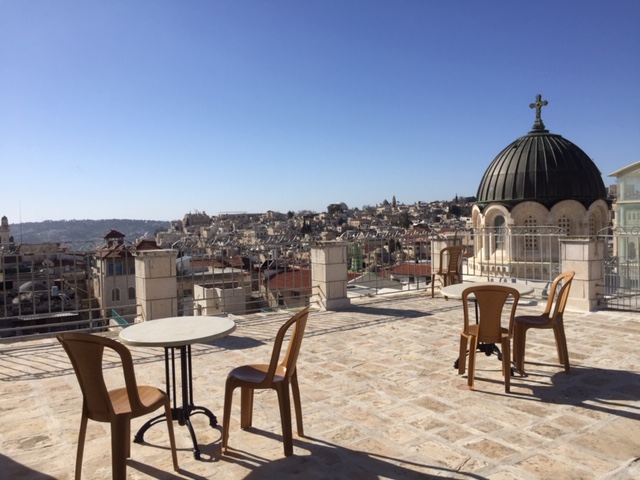
Each volunteer is assigned a terrace to sweep, plants to water, etc. , at least weekly. Mine is on the third floor (which is actually the fourth level). The top of the third floor terrace is one of the most awesome views in all Jerusalem. What do I do up there? Replace the trash can bag and…IMG_7797

clean the ash tray. (See resultant dirty rag.)

One of my jobs is wiping outdoor tables and chairs. Can you believe the beautiful dome of the Ecce Homo Basilica is one of our everyday sights?!

IMG_8728

IMG_8697

On warm, sunny days (especially welcome this cold, rainy winter), I’m to set out tables and chairs in inviting clusters. It made me happy to see a Swiss guest with a cup of freshly-squeezed pomegranate juice, waiting for friends to join her.

HOUSEKEEPING

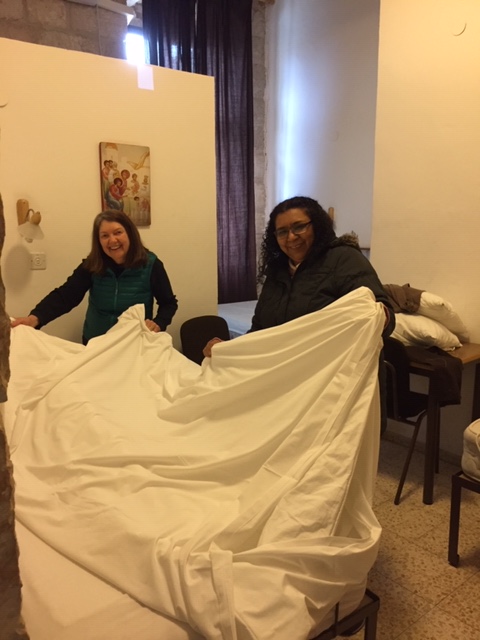
When Ecce Homo is slammed, like 70 guests leaving in the morning and 70 more arriving a few hours later, we’re scheduled, in pairs, to help make beds. The trickiest part is wrangling a cover onto a duvet. I’d never done this before, and was pathetically inept at first. It’s not like a YouTube with American duvets! But Sister Erika (from Brazil) is helpful and has a full-throated laugh which brightens my day. 🙂

IMG_8659

PS – Regrettably, these few pictures of guests don’t show much diversity; we’ve served guests from many other countries as well, but there wasn’t a natural opportunity to photograph them.


Sights, Sounds, Aromas During a 1 Hour 23 Minute Walk

On Thursday morning, Feb. 6, after my job prepping & serving breakfast for several tables, and Mike’s job drying & putting away dishes, Mike suggested we go for a walk before lunch, because we finally had sunny, warmer weather. Here are our multisensory experiences during the next 1 hour and 23 minutes — less time than it takes me to run errands in Salisbury! Our walk took us through the Muslim, Christian, and Jewish quarters. (Quarters just meaning sections, not literally 1/4. The other section is the Armenian Quarter.) FYI, Ecce Homo is in the Muslim Quarter.

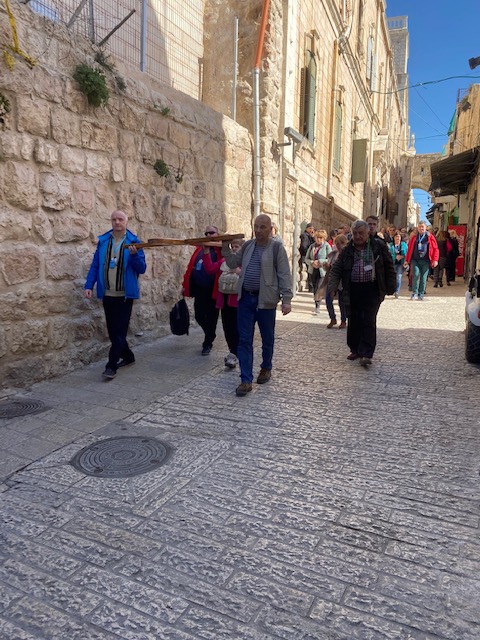
9:55 a.m. As soon as we stepped out of Ecce Homo, here was this procession of pilgrims singing, a relatively common worshipful occurrence on the Via Dolorosa.

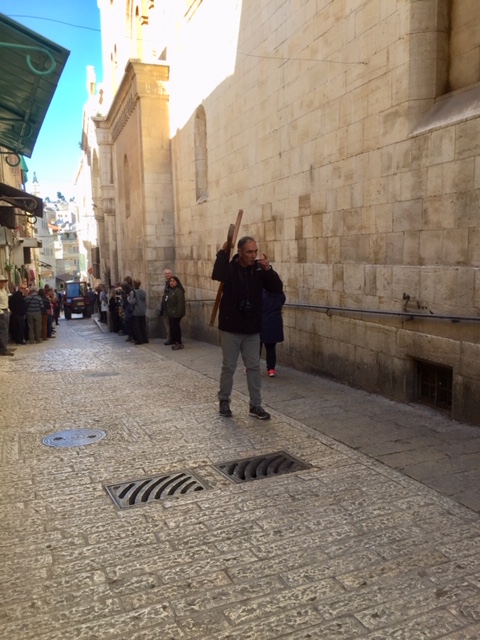
9:56 Man carrying a cross & drinking coffee. Note the little burgundy-colored truck in the background. This is how things are delivered in the Old City. When you hear a vehicle like this or a motorcycle, etc., behind you, if you don’t walk (or jump!) to the edge of the road, it will beep at you. Not a rude honk, more like the beep beep of a golf cart-like vehicle in an airport for people and luggage.

IMG_8542
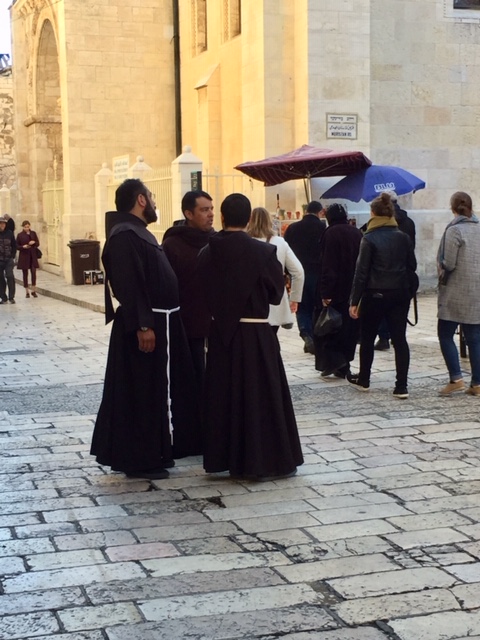
10:05 Franciscan friars near Lutheran Church of the Redeemer

IMG_8545

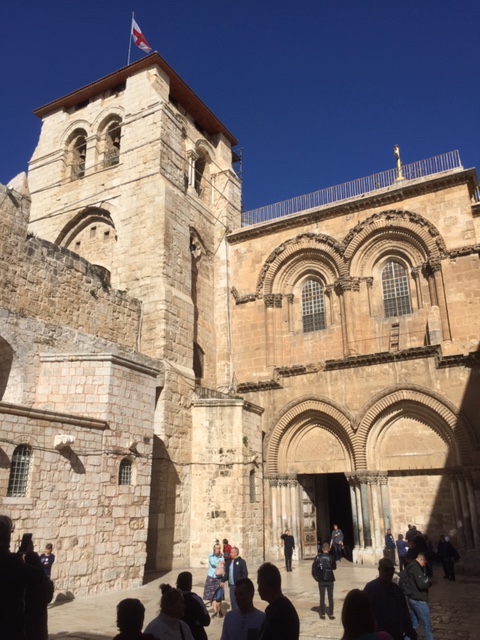
Also about 10:05 Church of the Holy Sepulchre in the sunlight. According to Christian tradition since at least the 4th century, this is the site of both Calvary and the empty tomb.

IMG_8546
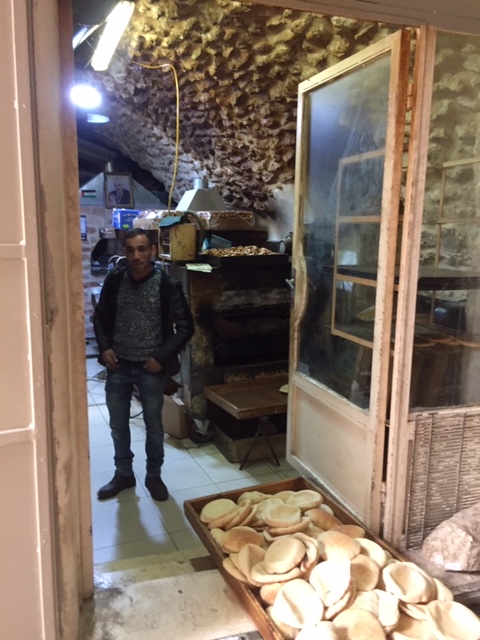
10:09 A neighborhood bakery where these pitas, straight out of the oven, smelled fabulous. Other aromas as we walked through markets included spices, freshly ground coffee beans, rotisserie chickens, and incense burning at shops selling it.

IMG_8547

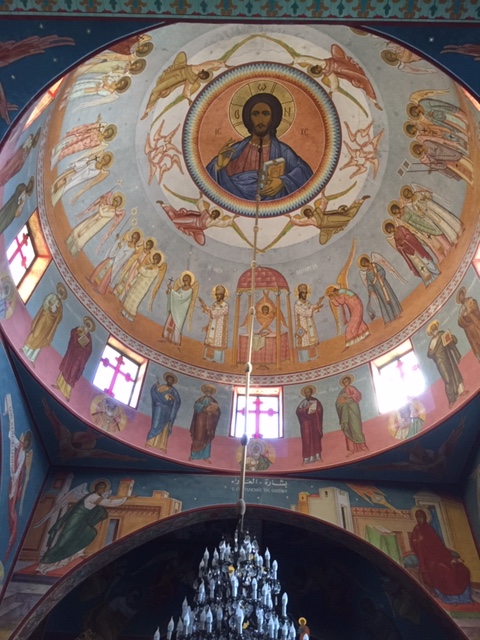
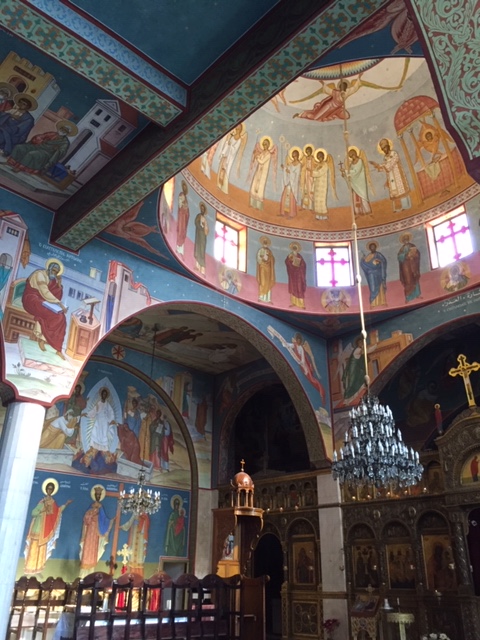
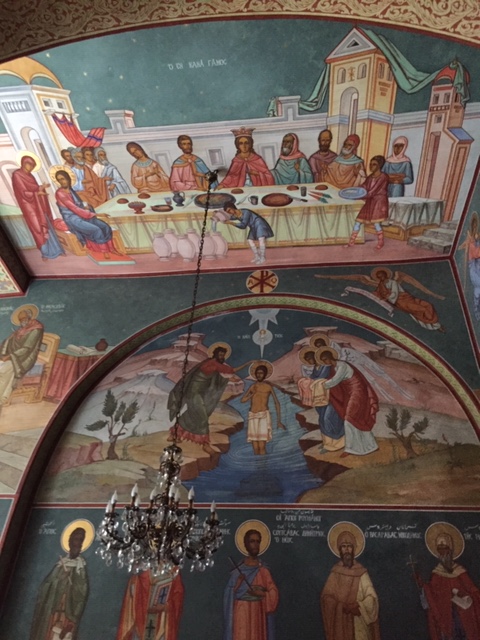
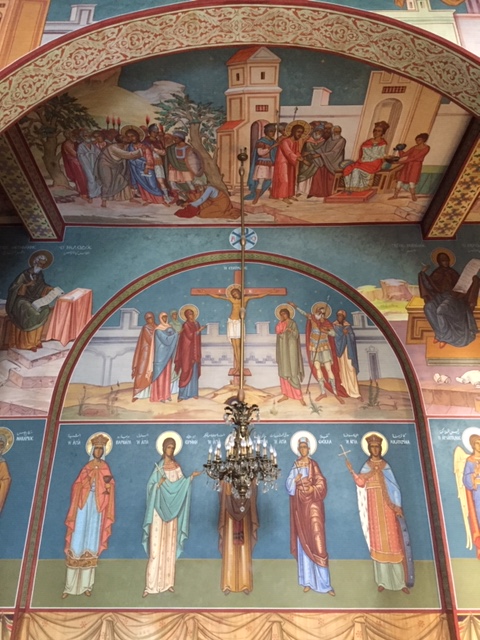
10:14 a.m. Inside the gorgeous Greek Catholic Patriarchate church, with even the ceiling painted, sort of like the Sistine Chapel

IMG_8548

IMG_8562

IMG_8553

Jesus’ triumphal entry into Jerusalem

IMG_8558

Jesus’ baptism and the Last Supper

IMG_8551

10:37 Outside the Jaffa Gate, a guitarist playing “Sunrise, Sunset” from “Fiddler on the Roof.” The windmill at the end of the video is called the Montefiore Windmill.

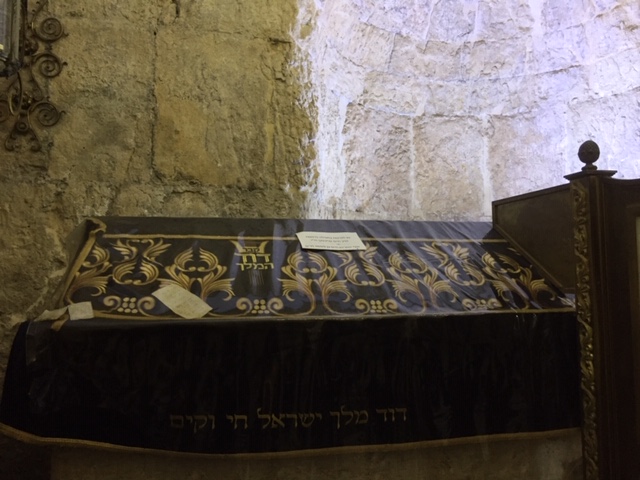
10:52 King David’s tomb        (Wikipedia says this “is a site considered by some to be the burial place of David, King of Israel, according to a tradition beginning in the 12th century. The majority of historians and archaeologists do not consider the site to be the actual resting place of King David.)IMG_8564

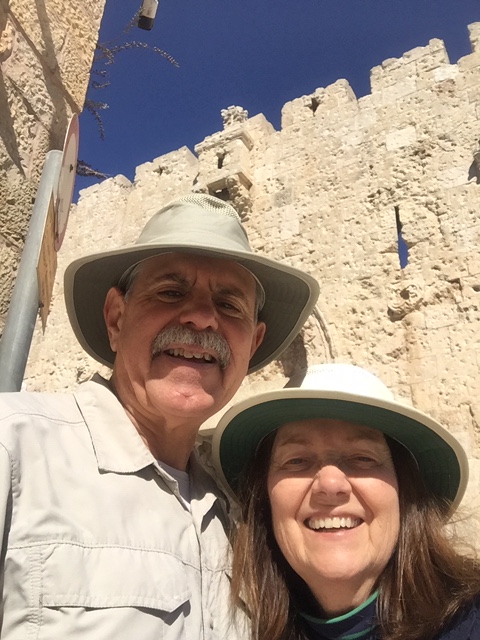
10:57 Zion Gate, leading into the Jewish Quarter. Bullet holes are from the 1948 Arab-Israeli War. In Israel, this is known as the War of Independence. In Palestine, it’s known as the Nakba (Arabic for Catastrophe).

IMG_8568

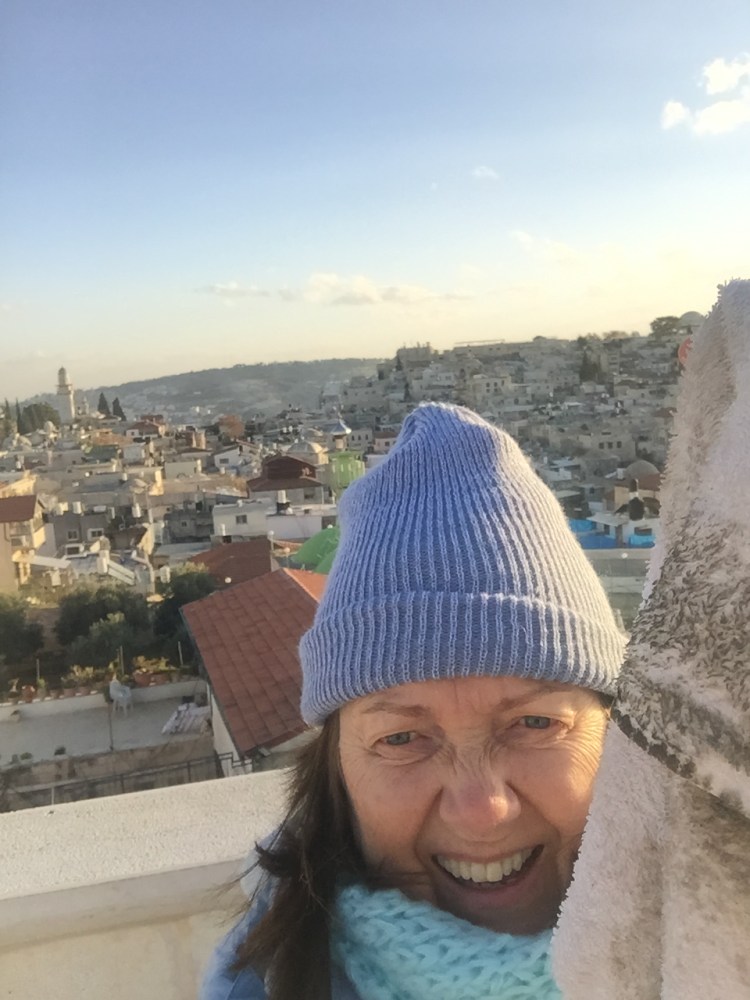
10:58 Selfie at Zion Gate

IMG_8572

11:04 Men in the Jewish Quarter exuberantly celebrating something — a bar mitzvah? — by dancing the hora.

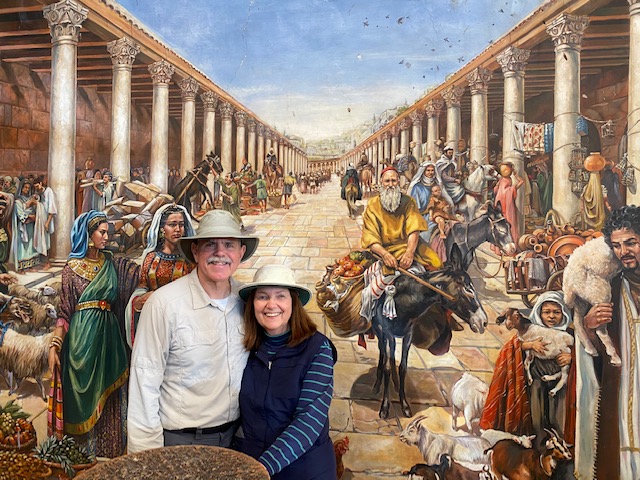
11:08 This backdrop is in the Cardo (name for main street in ancient Roman Empire cities) in the Jewish Quarter. A guide from Argentina took this pic for us.

IMG_0246
11:18 Pilgrim group carrying cross on the Via Dolorosa as we got back “home” to Ecce Homo.

IMG_0247
.


Sauntering

“People ought to saunter… Do you know the origin of that word ‘saunter?’ It’s a beautiful word. Away back in the Middle Ages people used to go on pilgrimages to the Holy Land, and when people in the villages through which they passed asked were they were going, they would reply, ‘A la sainte terre,’ ‘To the Holy Land.’ And so they became known as sainte-terre-ers or saunterers.” John Muir

I (Michael) like John Muir’s quote not only because I learned about the origin of a word and its tie to the Holy Land, but more importantly, because it encourages a contemplative state of mind. This is easier for me to say than to put into practice. I appreciate contemplation but still find it challenging to live in the present, since I’m accomplishment-oriented and always ready for a new adventure.

Given the time and effort to come the Holy Land, most people want to maximize their experience. I tend to translate this to going to the next site when I have some free time. After all, B.J. and I only have 3 months here. It’s fun to have these experiences, but over time they tend to blur together. I’ve come to realize that a better “maximize the experience” option is contemplative sauntering.

There are numerous saunterers in Jerusalem who provide great examples for me. You can walk across the Old City in 20 minutes and see people worshiping, praying, singing, and sometimes dancing before God. A recent eastern European pilgrim group stayed at Ecce Homo. Instead of being the first ones to breakfast because of their itinerary, this group came to breakfast after attending morning Mass. On two consecutive days, they had a community Bible study and prayer time for about an hour before heading out to holy sites. I initially caught myself thinking they could be experiencing so much more of Jerusalem when, in fact, they likely were being incredibly blessed by pondering scripture and praying.

There are plenty of opportunities to saunter across the Holy Land. We recently visited Capernaum and came upon this contemplative opportunity on the northern shore of the Sea of Galilee.


Recent experiences about sauntering go beyond contemplating at special sites. The five Sisters of Sion who live here at Ecce Homo have introduced us to Entry into Sunday. It’s a simple Saturday evening practice which is based on a scripture selection from the next day’s (Sunday) liturgy.

A different sister facilitates Entry into Sunday each week. It includes lighting a candle, singing a hymn, reading the selected scripture, spending a few minutes in contemplative thought, discussing  thoughts about the passage, and closing in prayer. Afterward, we have dinner together at the sisters’ table. In addition to being a pleasant Saturday evening of community, it enriches my Sunday worship. I’m a slow learner, but sauntering is truly the way to “maximize the experience.”

Running and Fun Facts

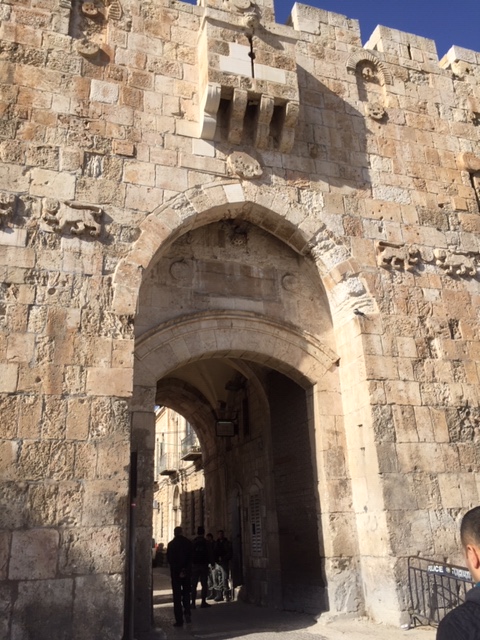
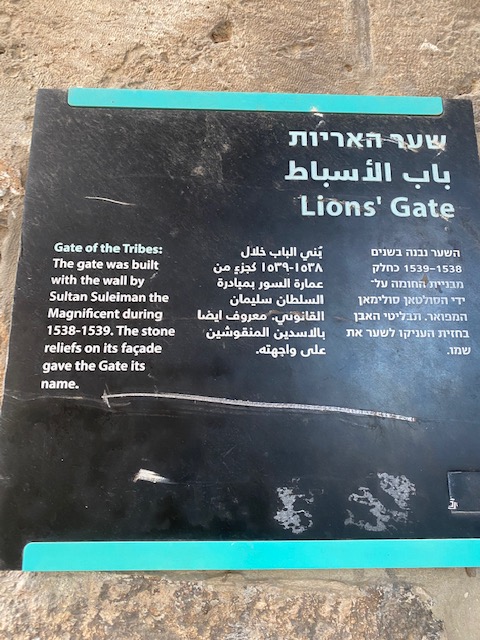
I (Michael) still enjoy running. At 68, I’ve definitely slowed down and typically stick to 3 – 4 mile distances (5 – 6.5 kilometers for you metric internationals). Even though Herod the Great shaved the top of Mt. Moriah to have a level temple court, I quickly learned that you can’t avoid steep hills when running in Jerusalem. My shortest route is actually the most challenging. I leave the Old City via the Lions’ Gate and run along the outside of Old City wall. A fun fact is that the Old City perimeter is three miles long.

IMG_3660
Lion’s Gate

IMG_0158

IMG_8361
Ecce Homo guest seeking running route recommendations from Michael at breakfast

Here are some other Jerusalem fun facts:
Best days to run are Friday (Islamic Holy Day) and Saturday (Jewish Holy Day) due to less pedestrian and vehicle traffic.
Most popular sports cap for both Israeli and Palestinian locals: New York Yankees.
Most popular pants for both Israeli and Palestinian teens: skinny jeans.
Many Israeli and Palestinian young children walk to school without parental supervision.
Both conservative Jewish women and conservative Muslim women wear head coverings.
Many conservative young Jewish families and Muslim families have more than two children.

Here are some Jerusalem ‘not fun” facts:
Even without signage, it’s apparent when you are in east Jerusalem vs. west/new Jerusalem. Although it is all one municipality, the level of public service (street maintenance, trash collection, etc.) is higher in west Jerusalem, where Jews primarily reside, than in east Jerusalem which is primarily Palestinian residents.
Some Jews run as an exercise. Some Palestinians run to work, school, and to get in line at the checkpoint.
Palestinians who reside in east Jerusalem pay taxes and are part of the the municipality of Jerusalem but are not Israeli citizens.
Like most of us, both Jews and Palestinians consider going to a government office to renew a license or government ID a necessary nuisance. However,  Palestinians  may be asked questions like “Where specifically in Jerusalem were you born?” or “What are the full names of your grandparents?” even when they are renewing a previously issued government ID. Some dread these type of questions because if they don’t have the answer it delays their renewal.

As most everywhere, fellow runners in Jerusalem acknowledge one another with a smile, nod, wave, thumbs up, etc. I also have been pleasantly surprised by encouraging encounters with non-runners. One morning while I ran the perimeter of the Old City, Israeli soldiers were patrolling through the Arab cemetery near Lions’ Gate. It was at the end of my route, a fairly long and steep ascent. As I ran by, a female soldier said, “Good job!” I said, “Thank you.” On another day and different route, a Palestinian taxi driver stood beside his vehicle, pointing to the left. I initially thought he was jokingly pointing me to enter his cab. As I got closer, I realized he was warning me to get on the other side of the road due to construction up ahead. I expressed my appreciation by saying, “Shukran” (thank you). He replied “Afwan” (you are welcome) and “Please be careful.”

Lastly, one morning I missed regularly scheduled breakfast because of a run. One of the Ecce Homo volunteer perks is that you have access to the breakfast kitchen, so I went there. I explained to Maha and Nazira, Ecce Homo dining room staff, that I was eating late because I’d been running. They both replied, “Bravo, Michael!” It was the first time I ever heard those two words refer to me 🙂

IMG_0257
Staff members and volunteers in breakfast kitchen: from left, Mohamed, Michael, Philippine, Maha, Nazira, B.J., and Sister Erika)

“Come, follow Me,” Jesus said, “and I will make you fishers of men.” Matthew 4:19

(If you have limited time, skip to Part 2.)

Sunday morning, January 26, when I (B.J.) woke up, one of my more exciting thoughts was, “Boiled eggs!” (Monday through Saturday, we have a buffet of corn flakes, granola, plain yogurt, fruit, pita & sliced bread, butter & jams, hummus, vegetables, cheeses, and thinly sliced meat for breakfast, but Sundays there are also boiled eggs.) Mike & I didn’t know that an encounter awaited us which would include eggs as well.

Part 1: Church

We worshipped at Lutheran Church of the Redeemer here in Jerusalem. There were several U.S. ELCA bishops present, in the Holy Land to celebrate the paying off of the mortgage of a church near the site of Jesus’ baptism, Evangelical Lutheran Church at Bethany-Beyond-the-Jordan. Also, I think this was the fourth Sunday in a row that we saw Rev. Dr. Said Ailabouni, ELCA area desk director for Europe, the Middle East, and North Africa. Especially for a clergyman with so much global responsibility, Rev. Dr. Ailabouni is a humble, low-key man.

He urged Mike and me to tell the bishops in the pew in front of us, about ourselves. As soon as Mike started to talk about a covenant relationship with Christmas Lutheran Church, the bishop from South Carolina asked, “Are you with St. John’s in Salisbury?” We’re enjoying these serendipities.

Redeemer Pastors Carrie Ballenger and Fursan Zu’mot led this joint Arabic-English service. The gospel reading was from Matthew 4, including Jesus telling Peter and Andrew, “Follow Me, and I will make you fish for people.” In Pastor Zu’mot’s sermon, he asked how one can fish for people in Jerusalem, with so much division and hatred.

He told a story about a group of Messianic Jews offering a playground where their children and Muslim children could play together. When the Messianic Jews offered food, at least one of the Muslims was skeptical: wasn’t any male wearing a yarmulke his enemy? But as the hosts shared Jesus’ love through their actions, maybe the Muslims could never think of them the same way, or maybe they’d have doubts about hating them, or maybe they’d at least count to 10 before considering them an enemy.

IMG_8156
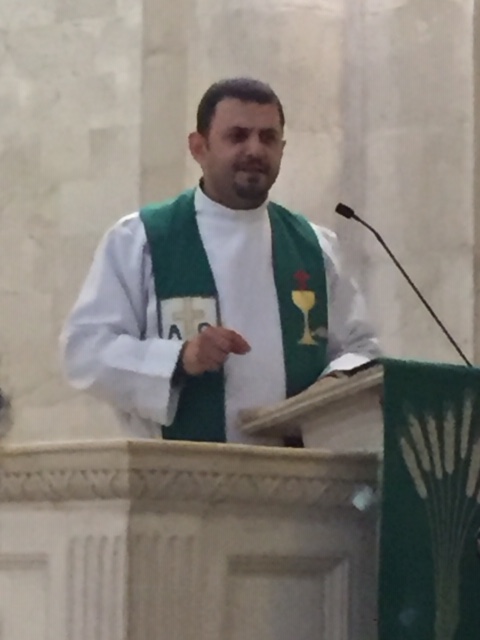
Pastors Ballenger and Zu’mot
IMG_8154
Pastor Zu’mot preaching

Part 2: A Man Named Israel

As Mike and I were walking to lunch and a 1:45 tour, a Jewish man, who said his name is Israel, struck up a conversation with us, asking if we’re Jewish. When we said, “No, we’re Christians,” he seemed defensive that we might automatically try to convert him. But he seemed interested in a dialog about God.

IMG_8177
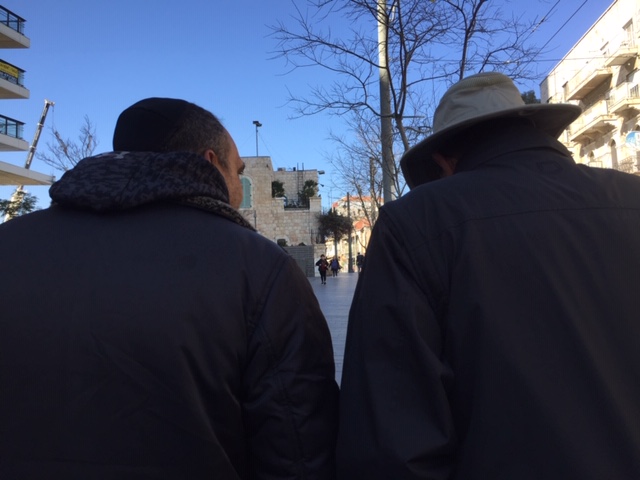
Israel and Michael walking and talking

He showed us photos of his parents, whom he said are Holocaust survivors he was on his way to visit. He asked for help for them. I’ll show you photos in person, but not by e-mail.

I’ve been approached by so many people in so many places over the years, sometimes I feel like I must have a sign on my back saying, “Gullible sucker!” I try to be discerning — I think I’ve developed pretty good radar for scammers. But Mike and I both felt moved to engage with this stranger.

Israel asked where we’re from and why we’re in Jerusalem. When we told him we’re from the U.S., to volunteer at a pilgrim house on the Via Dolorosa, to see holy sites, and to meet “living stones” like him, Israel was incredulous. “You came all this way to work?

He talked about the Jews being the chosen people, and asked about Jesus. Mike said, “I believe Jesus is the promised Messiah.” When Israel asked how Jesus feels about Jews, Mike said that Jesus was a Jew, and Jesus loves everyone. Israel brought up the age-old question which is, essentially, “How could a loving God allow evil like the Nazis?” Mike said, “I don’t know why God allowed the Nazis, or evil like child abuse and slavery. I just don’t know. But He gives us free will, and sometimes people make terrible choices. God hates the sin but loves the sinner.”

We talked about how God wants us to help others. I told Israel that, when we lived in another state, we had a Jewish neighbor whose husband was in the hospital. “I told her I was going to sleep in my clothes and, if she needed to go to the hospital at midnight, to call and I’d come stay with her girls. And that’s what happened.” It seemed like news to Israel that Christians are called to serve others. “So you’re commanded to help like Jews are?” “Yes,” I said.” ‘’Do unto others as you would have others do unto you’ – it’s called the Golden Rule.”

Israel seemed to think that we worship three gods. (We’ve heard that some Muslims have this misconception, too.) Mike and I took very different approaches to this. Mike emphasized our commonality with Judaism, saying, “We worship the God of Abraham, Isaac, and Jacob.” I used the egg analogy to try to explain God as Father, Son, and Holy Spirit. “An egg has three parts — shell, yolk, and white – but is still one egg. Three in one.”

Israel asked , “Can we step aside and talk?” I said we were headed to lunch, Mike said we had an appointment. “Just five minutes?” Israel asked. Mike said ok. Israel asked, “Can you pray for my parents?” We said, “Certainly.”

As we walked to a nearby bench, Israel said he tries to spend a lot of time with his parents, but it’s hard, with a family of his own. I asked, “Do your parents have nightmares?” He said, “They cry every night.”

When Israel sat on the bench, I asked, “Are you comfortable with us holding your hands in public?” He said yes. So we held his hands and prayed for him and his parents by name. Part of my prayer included saying, “The Bible says we’re to rejoice with those who rejoice, and weep with those who weep.” When we finished, Israel saw tears on my face. He said, “I feel bad. I didn’t mean to make you feel bad.”

We said we wouldn’t give him money, but we’d buy groceries for his parents – what did they need? We went into a market with Israel and bought meat, milk, eggs, etc.

I took an Ecce Homo business card out of my pocket, scrawled on the back, “Mike + B.J. until March 25” in case Israel wants to visit us, and handed it to him. When we parted, Israel spontaneously hugged Mike, asked permission to hug me.

Two sayings come to mind: “Evangelism is one beggar telling another beggar where to find bread,” and “People won’t care how much you know until they know how much you care.”

I suspect that Israel did indeed scam us. But it was well worthwhile if he got the message that Jesus and these two American Christians care about him. We weren’t consciously “fishing” for anyone, but it felt like a fish jumped into our boat! If that “fish” scammed us for food, it’s ok. Fish have to eat, too.


Joy of Service

It’s always a blessing when your passion, skills, and purpose align when serving others. You may be physically tired or emotionally drained, but still you know it’s what you’re called to do. You realize you’ve provided value and you have a sense of your true self. It doesn’t have to be a spectacular accomplishment. In fact, most of us realize these blessings in simple everyday encounters rather than milestone events or large initiatives.

Ecce Homo guests can be quite appreciative when you serve them meals and help them at the reception desk, but many of our task assignments are quite basic functions which go largely unnoticed. The Ecce Homo staff community are supportive and encouraging. Every day they point out things for us to learn or coach us on how to improve. As Maha, the dining room director, instructed us about cleaning and setting up breakfast tables, she stressed, “We are a team,” and thanked us for being there.

I enjoy most of the assigned tasks, but my favorites are actually polar opposites – reception, and solitary tasks like sweeping and mopping. Sweeping the outside steps at 6:45 a.m. is a holy moment for me, as I reflect on all the pilgrims who will be entering Ecce Homo that day. What countries will they be from? What prayers will they lift up while meditating on Jesus’ suffering and death on their behalf? What parts of the Old City will be their forever memories? Believe me, these reflections are quite helpful when removing cigarette butts, candy wrappers, and other assorted trash from the outsides planters.

There is a public viewing area behind the Ecce Homo Basilica. The doors are open every day to anyone passing by on the Via Dolorosa. One of my ongoing assignments is to keep the area clean, including sweeping and mopping. Many approaching pilgrims pause, deciding whether it’s worth their time to step in and look through the Plexiglass. I enjoy encouraging them to do so. When they do, I describe how the three arches built by Roman Emperor Hadrian in 180 AD were originally a marketplace entrance on the outskirts of ancient Jerusalem, and how one of the smaller arches is now incorporated as part of the altar in the Ecce Homo Basilica. Click on Hadrian Arch to see a schematic of the original Hadrian Arch with a depiction of the portion within Ecce Homo.


IMG_0080
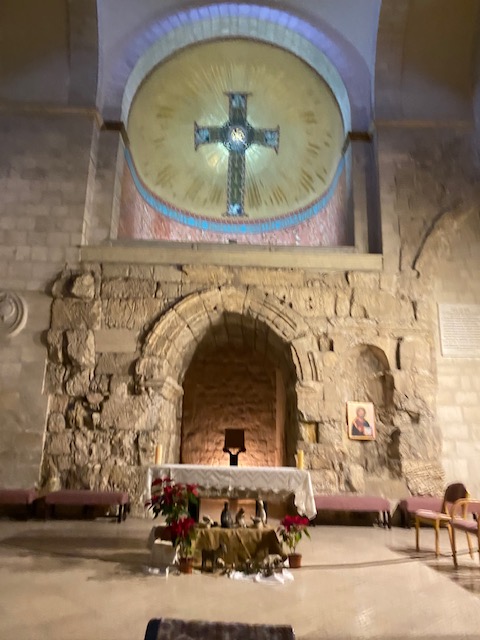
Ecce Homo Basilica incorporating Hadrian Arch

The Ecce Homo community is special. Sure, there are discussions like, “What do you think about Harry and Meghan?” But we all are very interested in immersing ourselves in the people, culture, and biblical sites of the Holy Land. We also have a lot of fun. One of the volunteers, Clarisse, is a French college student. She’s taking a break before deciding on a major, by serving at Ecce Homo. In an effort to learn Arabic, she spends time with Palestinian staff. Nahla, a longtime Ecce Homo reception desk staff person, is fluent in four languages. Nahla has found that it’s easier to learn languages through song; she is teaching Clarisse Arabic love songs.

While working in the dining prep room, Clarisse sang one of these songs. I asked what it’s about. Clarisse said it’s a romantic song from a woman’s perspective, who says, “I write your name on every leaf of the tree but you only write my name in the sand.” There was another where the woman says she’s waited for the man all her life, but he can’t even wait a minute for her. Later, I asked Nahla, “Are all Arabic romantic songs about the woman loving the man more that he loves her?” Nahla said, “Yes, the woman is all about love.” I continued, “Aren’t there any songs about ‘I love you, you love me, we are happy’?” Nahla smiled and said, “Yes, those songs are sung by Barney the pretend dinosaur.”

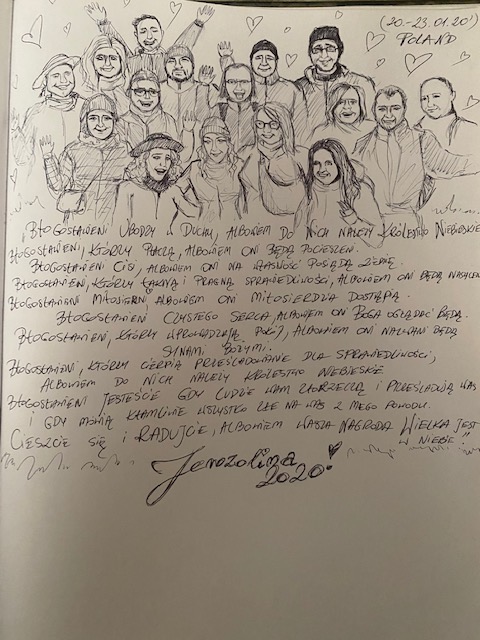
A recent guest shared that this was his second time visiting Jerusalem and staying at Ecce Homo. He said coming to the Old City was quite special, and that Ecce Homo was part of that experience. A group of Polish pilgrims also stayed at Ecce Homo for several days. In addition to the typical tour day excursions, they reserved the Basilica for morning and evening prayers, as well as for Mass. Upon departure, they had a unique way of signing the Ecce Homo guestbook, expressing their appreciation. In addition to having a talented artist who depicted everyone in their group, they wrote out the Beatitudes in Polish.

IMG_0145
Polish Pilgrims’ Ecce Homo Guestbook Entry