The Power of Love

Don’t need money, don’t take fame

Don’t need no credit card to ride this train

It’s strong and it’s sudden and it’s cruel sometimes

But it might just save your life

That’s the power of love

That’s the power of love

  • Huey Lewis, 1985 

I know I’m showing my age but who doesn’t like the movie Back to the Future and its theme song, The Power of Love? Although the movie and song are about teenage romance,  the words point to the greater truth – there indeed is the power of love.   “Love the Lord your God with all your passion and prayer and intelligence. … Love others as well as you love yourself.”  Matthew 22:37 – 40 (The Message). We needn’t regard this as something we ‘should do’ but rather it completes us.

We all get this, right? However, we tend to forget the “all your passion and prayer and intelligence” part. We tend to put conditions on how we love, when we love and who we love which diminishes the power of love.
image
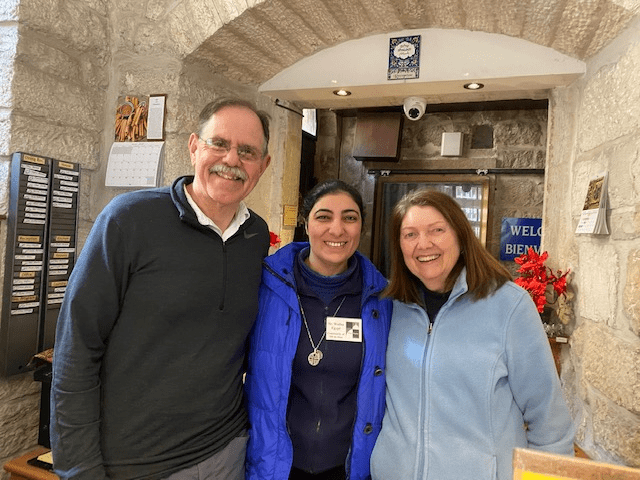
With Sister Wafaa at Ecce Homo Reception Desk

One of B.J.’s and my new friends at Ecce Homo Pilgrim House is Sister Wafaa, who is a member of the Sisters of Our Lady of Sion (Notre Dame de Sion) community here. She is from a small Egyptian village, Albrba in the Menia governate of Egypt. Albrba is located close to the Nile river, a very fertile land area. Recently a boy from her village was on Voice for Kids (Arabian version), a talent  competition. The first three minutes of the following video show the beauty of her agrarian village. Wafaa knows the boy’s family. His grandfather encouraged his love for singing. Here’s the link – https://youtu.be/64CLZONKM1E

Sister Wafaa’s village has one Christian church and ten mosques. In addition, the Sisters of Our Lady of Sion have a kindergarten for young children who are mentally challenged. There, about fifteen students learn how to read, write, and practice socialization skills. 

You may be aware of the persecution which Coptic Christians face in Egypt regarding attacks during church services and kidnapping of girls by Islamist extremists.*  While Sister Wafaa was serving in her village, there was word of an impending threat on the church and Sisters of Our Lady of Sion convent and kindergarten. The village’s response to the threat was one of solidarity.  Leaders from the church and the mosques organized protection vigils for the church and kindergarten. They surrounded the area for two days. Sister Wafaa shared that the police asked the sisters to evacuate for one night. The police said, “It’s okay if the buildings are destroyed but not your lives.” The sisters were able to safely return the next day. False alarm? Probably not, since the Christian church and schools in a nearby villages were destroyed that same night. 

So why do Muslims and Christians get along so well in Sister Wafaa’s village? She simply attributes this to love of God and neighbor exemplified by the Sisters of Our Lady of Sion kindergarten. Their school serves both Muslim and Christian children in the area. These villagers appreciate each other to the point of protecting each other. 

Sister Wafaa is now serving at Ecce Homo in the Old City, Jerusalem. Like all the Sisters of Sion her plate is quite full. She has helped train B.J. and me on a variety of tasks, particularly reception (front desk). In addition to her Ecce Homo responsibilities, she serves at a soup kitchen on Thursdays. We had the pleasure/privilege of accompanying her January 16.

The soup kitchen is affiliated with Meir-Panim Supplementary Relief Centers (https://meir-panim.orgJerusalem). In addition to hot lunches, the organization provides food shopping cards and after- school program assistance. It serves a great need across Israel. But we also marvel at the ‘love your neighbor” example of an Arab Christian from Egypt working alongside an Israeli rabbi, serving  Israeli citizens in need, who are mostly Jews. 

Sister Wafaa’s living siblings are older than she – her sister is 20 years older and brother is 17 years older. One of Wafaa’s nieces (her sister’s daughter) is three years older than Wafaa. Typical of Middle Eastern  families, her brother and his family live in the same house as Wafaa’s parents. 

Wafaa’s family has experienced quite a bit of heartache. She had another older sister who unfortunately died of a heart condition at the age of twenty.  Wafaa’s mother had four miscarriages before Wafaa was born.

Wafaa’s father was a builder and farmer who  grew corn and wheat. He regularly read his Bible and used to quiz Wafaa on scripture. She didn’t much care for this and, at times, would run and hide to avoid having to answer the questions. 

Wafaa became interested in being a sister at the age of 11. There was a vocational day trip to Al Minya where the Catholic students saw a film about a sister serving the poor. This appealed to Wafaa. She shared her thoughts to her older niece who responded, “No, no. You wouldn’t make a good sister.”

Her father initially objected. He wanted Wafaa to be married and have children. Although he had grandchildren from both his son and other daughter, he wanted to enjoy Wafaa’s children. 

He told Wafaa “Jesus didn’t live in a convent. Why do you have to?” Her father also told Wafaa’s mother, “You are to blame for this.” Wafaa’s mother was surprisingly silent. Her father eventually relented and told Wafaa, “It’s your life, do what makes you happy.” 

She entered into community with the Sisters of Sion at the age of twenty. On January 9, 2011, after six years, Wafaa made her first vows. Afterward, she came home to visit and celebrate. Her cousin asked Wafaa’s mother, “Why did you allow her to go to the convent?”

Wafaa’s mother broke her silence  on the subject by responding, “After losing so many children before I was pregnant with Wafaa, I prayed, “God, if you allow this baby to live, I will give her to you.”

Hopefully, Sister Wafaa’s and her family’s life experiences are an encouragement for all of us to grow in our unconditional love for God and neighbor. This indeed creates more power which, in turn, furthers His kingdom.

* The article, Christian leaders in Egypt reflect on persecution of Coptic minority, in the following link provides insight on the current situation in Sister Wafaa’s home region of Egypt. 

https://cruxnow.com/church-in-the-middle-east/2019/11/christian-leaders-in-egypt-reflect-on-persecution-of-coptic-minority/

A Visit with Pastor Munther’s Family, including Two of God’s Smaller “Living Stones”

Last week, Pastor Munther Isaac & his wife Rudaina kindly invited us to have lunch with them after service at Christmas Lutheran Church, Bethlehem. Their boys Karam (7) & Zaid (5) remind us SO much of our grandsons Theo (5) & Sean Michael (3), playing together, getting into mischief together, etc. At home, one of the boys, holding up his right index finger, begged, “Wahid!” (Arabic for “One!”), pleading for a cookie. A little boy, whether in the U.S. or in Palestine, figures you might as well try for a treat before lunch, even though you know the answer is going to be no.

When Karam & Zaid came close to thank Mike and me for a gift, we had the privilege of hugging them. I gave them each a bear hug, lifting them off the floor the way I do Theo & Sean Michael.

I showed them, on my phone, a video of Theo and Sean Michael wrestling with Mike — they liked it. Mike showed them a photo of himself with his bees. Karam asked in wonder, “How did you catch them all?”

They live in a town called Beit Sahour, near Bethlehem, in the house Munther’s father built in the 1970s. Munther & Rudaina added two bedrooms to it when they got married. Munther’s (widowed) mom & professional, single sister Mona live upstairs. It’s very common to have multiple generations in one house. I think this is a great image for John 14:2, where Jesus says, “In my father’s house are many rooms. If it were not so, would I have told you that I go to prepare a place for you?”

Architect Rudaina designed the remodel they recently had done. Now it’s a lovely, modern, open floor plan.


Hit the Ground Running

Michael asked me in 2017, “Would you consider us applying to be volunteers together at Ecce Homo?” I admit that my motives for saying yes weren’t entirely noble.
True, I wanted to make Mike happy, it would be an adventure to serve as “ambassadors for Christ” together, and we’d be able to partner with our friends at Christmas Lutheran Church in Bethlehem some Sundays. But it also seemed like something of a lark, in a world-renowned city. The guest house would give us room and board for working 30 hours a week – the rest of our time, we could be tourists. I told friends, “We’ll be doing things like serving meals, staffing the front desk, watering plants, and sweeping terraces – it’s not brain surgery.” How hard could it be?
Pretty darn hard! At least in the beginning.
Ecce Homo is excellently run like, to use the cliché, a well-oiled machine. Although it’s neither a hotel nor restaurant, the work is similar. Each week, Sister Rita (our director, from Canada) hands us assignment sheets with our names and jobs highlighted. (Mike & I are generally assigned as individuals, not as a couple.) Our first morning here (Wednesday January 2), the pink highlighter showed I was to do breakfast “wash up” at 7:30, followed by training in “reception” from 10:30 to 12:30. After breakfast, I headed to the wash up room, next to the three dining rooms.
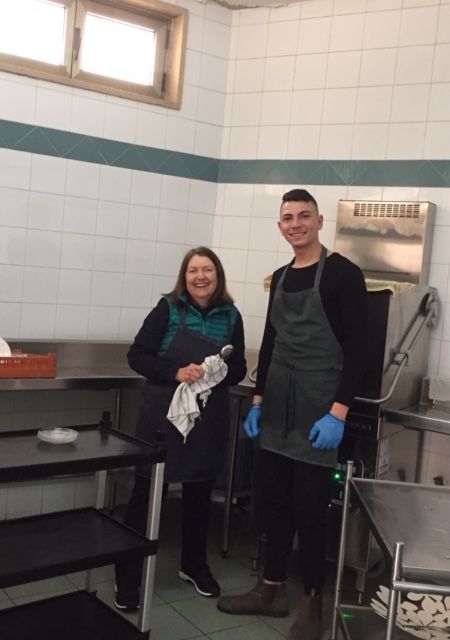
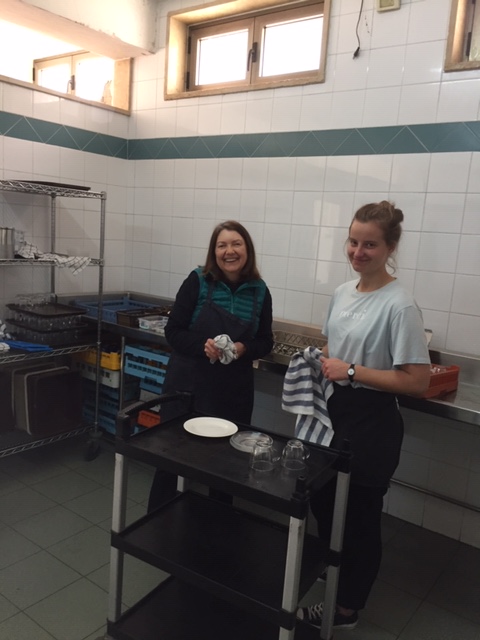
There’s a commercial washer for dishes and utensils, which I was slightly familiar with from helping at our kids’ elementary school cafeteria years ago. Fortunately, a young local man named Jonathan operated that, while a young French volunteer, Clarisse, and I dried. We all wore dark aprons. I needed to learn where to put the big and small plates, big and small forks, cereal spoons, soup spoons, small spoons, breakfast knives, dinner knives, glasses, serving spoons, water pitchers, milk pitchers, where to hang wet dishtowels, etc.
Clean trays of steaming bowls and cutlery from the washer came thick and fast. I struggled to keep up, feeling like I was in the “I Love Lucy” candy factory episode, where Lucy and Ethel, at a conveyor belt, struggled to keep up with wrapping chocolates.
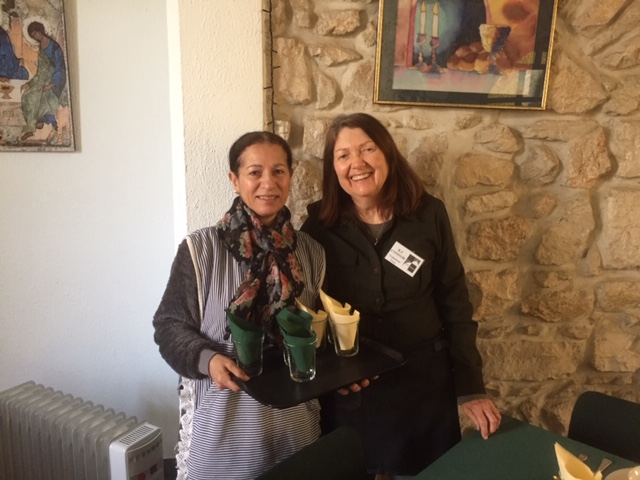
The director of the adjoining breakfast prep room, Maha, came over and introduced herself in a gentle voice, saying, “We are a team. We are a family.” Jonathan, Clarisse, Maha, and her coworker, Nazira, were patient with rookie me. As we handed each other a tray or serving dish, we could say “Thank you” in English, Arabic (“Shukran”), or French (“Merci”).
Jonathan made the mistake of telling me it was his birthday. I announced to everyone who walked into the wash up room, “Today is Jonathan’s 16th birthday!” I led two groups in singing “Happy Birthday” to him. Like any teenager with a doting but somewhat annoying grandmother, Jonathan seemed embarrassed but also smiled at the attention.
After I mopped the floor, I was off to two hours of training at the front desk. So much to remember – too much for this blog post.
Ah, but the payoffs! One was after training, as Michael and I walked upstairs for lunch. We climbed up to the third floor terrace for a view of Old City Jerusalem. Almost everywhere you look is like a post card.

image1
With Jonathon
image2
With Clarisse
image3
With Maha
image4
View Overlooking Old City with Redeemer Lutheran Church Tower in Background

Pilgrim vs. Pilate

People from around the world come to Ecce Homo (“Behold the Man”) guest house (eccehomopilgrimhouse.com), to see the ancient Lithostrotos (Greek for pavement) in the basement. There is also, carved on flagstone, a game soldiers would have played with dice, maybe similar to when soldiers threw dice for Jesus’ robe.

This area may be where Jesus suffered at the hands of the Roman soldiers, and where the trial by Pontius Pilate took place. Below the guest house, there is a remnant of stone pavement which Emperor Hadrian had moved from the Antonio Fortress in 135 AD; it’s possible that Jesus walked on these very stones. The Bible says, in John 19, that after Pilate told the angry crowd that he found Jesus not guilty, “Jesus came out wearing the crown of thorns and the purple robe. Pilate said to them, “Behold the man!”

As the Roman governor of Judea, Pilate was tasked to maintain order and assure that Judea contributed to the continued success of the Roman empire. That meant balancing military control while assuring a productive economy. Prior to handing Jesus over to the chief priests and officers to be crucified, Pilate has a talk with Jesus which concludes with Pilate’s famous rhetorical question, “What is truth?” He’s so preoccupied with his responsibilities, Pilate either can’t recognize when Truth is right in front of him, or doesn’t have the courage to defend Jesus. Authors, Mike Breen and Steve Cockram, of Building a Discipleship Culture would say Pilate missed a Kairos moment, the opportunity to learn from and act on divine revelation.

Those who visit Ecce Homo don’t do so to see where Pilate once ruled. Some are tourists, but most are spiritual pilgrims wanting to experience, meditate at, and worship at the physical locations commemorating Jesus’s life, brutal death, and resurrection. They are people of faith seeking a closer relationship with God.

Since you’re reading this blog, I (Michael) assume that you understand the pilgrim attraction to Ecce Homo, and aren’t intrigued about walking where Pilate walked. However, let’s be honest — there is a little of Pilate in all of us.

I confess that when I become preoccupied with a variety of tasks, I miss or actively ignore God’s revelations to me. It’s not only the busyness of life, but personal interests and priorities promote a self-centered focus. Unfortunately, the immediacy of life creates an environment where I find it much easier to feed my inner Pilate and starve my inner Pilgrim. This is self-destructive behavior. When I don’t see Truth staring me in the face, I’ve missed a spiritual growth opportunity. Thankfully, God’s love and commitment ensure that He’ll pursue me — and you.     

I’m not necessarily suggesting we should all be doing more good deeds.  Rather, I encourage all of us to spend more time nurturing our spiritual identity by attentiveness to divine revelation. Keep these two questions in mind: What is God revealing to me? What am I going to do about it?

Feed your Pilgrim, not your Pilate.


Starting a New Year and New Decade, in Jerusalem

From the Charlotte airport New Year’s Eve, it took about 18 hours to reach our destination, Ecce Homo guest house in Jerusalem – 8 and ½ hours to Munich, a 4-hour layover, 3 and ½ hour flight to Tel Aviv, shuttle ride to the Damascus Gate, wheeling our luggage over the bumpy cobblestones of the Via Dolorosa at nightfall, noticing Hebrew letters on a flashing green traffic signal. My suitcase and Mike’s duffel bag each weighed exactly the allowed 50 pounds, our backpacks almost the allowed 17 pounds.

During those hours in cramped airplane seats, we each got less than four hours of sleep. At midnight Eastern time — I assume somewhere over the Atlantic Ocean — Mike leaned over, kissed me, and said, “Happy New Year!” When we finally climbed the high steps leading up to the Ecce Homo back doorway and pressed the doorbell, we entered the building – and our new lives for the next three months – with great relief.     

Sister Rita, the Canadian Sister of Sion director of volunteers, and two volunteers we were succeeding, Amy from California and Janet from Canada, gave us a warm welcome and showed us to our room. Soon we joined other sisters (nuns) – Bernadette from Australia and Erika from Brazil – and another new volunteer, Erik from Norway, at dinner. There was delicious soup we all guessed was carrot (the chef would later tell me it was pumpkin), homemade croutons, and bread. I had read an Ecce Homo online review describing dinner as “simple, home cooked and good” so I thought, Maybe dinner is just this soup and bread. which would be fine.

Mais non! Next the server, a young French woman, brought salad, chicken, mashed potatoes, gravy, and roasted carrots. Everything was scrumptious! Then came homemade brownies. So much for my hope of losing weight during these three months.      

Sister Rita gave Mike and me the week’s work schedule. I looked at my duties for the next day, highlighted in pink: breakfast ‘wash up” and reception desk training.

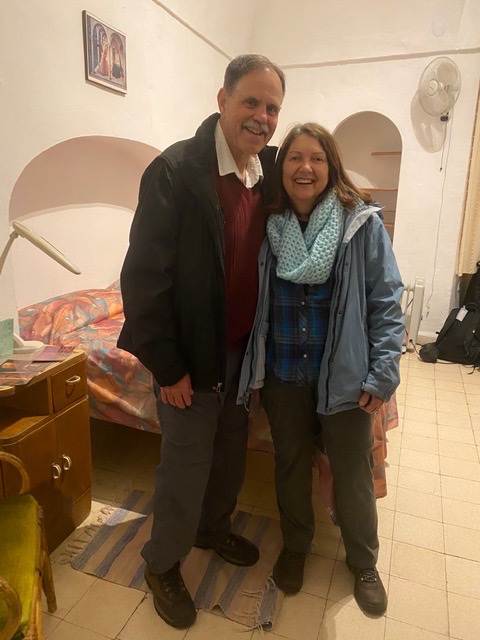
Mike and I got ready for bed. Our room has no central heat. Instead, in the bedroom, there’s a space heater on the floor and fan mounted on the wall, and in the bathroom, a wall-mounted water heater. The Old City plumbing, as we experienced in India, can’t handle toilet paper, so one puts one used toilet paper in a small covered wastebasket. Also, as in India, it would be safer for us to drink bottled or filtered water than from the tap. Especially in my sleep-deprived mode, it was a bit to remember: don’t flush paper, don’t drink tap water.

Even though we’d be in a stone building built in the 1800s, I had wondered if it was overkill to pack my heavier winter nightgown. Again, mais non! I went to bed wearing layers and socks, covered by a comforter, bedspread, and heavy blanket. Even so, my nose was cold. We would later learn how to turn the heater dial to a higher setting.

The next day would hold surprises, both good and challenging. But for tonight, I was giddy with gratitude to God for safe travel and for the bliss of being able to stretch out on a mattress. We prayed for loved ones. And then we slept like a rock. 

Home Away From Home

4c68f4b4-d921-4dfe-bada-d57f4ef78ba9